Feedback from "Flint" - an accelerometer system in the Smithsonian Museum
Flint is an accelerometer system in the Smithsonian Museum.
It is a MKI109 and MKI 210 pair. It has been in place for about three years after a recommendation from your David Reynoldson, who is a really great guy and helps a lot.
We have about six to ten such systems that were used and have now been pulled, but old Flint just keeps on working.
It has a partially bespoke C# program. The PI designed and manufactured some small boxes. But to hold the 210 onto the 109 I used a rubber band before it was boxed. It worked well for three years and then broke. Flint had some minor problems:
1. You have to use a USB Managed HUB to turn the device on and off if you reboot the computer. The HUB is as expensive as the accelerometer pair. Or you unplug the computer, the device does not reset to home if the computer is switched off - major design flaw in a complex system.
2. You have to put a watcher program to monitor the accelerometer program that can just stop running with no warning. The new Sensor TileBOX Pro has the same problem. I have not yet put in the watcher program nor got another USB Hub, so the PRO is a manual pull out the cables.
3. The frequency of the output is not constant, so it has to be monitored every 8 seconds and recorded with the data
and the FFT step adjusted.
4. They have no serial numbers but thankfully the PRO does, the number is so big it cannot be held as int in C#. The number is larger than the number of grains of sand in the world, statistically speaking.
5. It took me a month to work out Flint was not working because of the rubber band and not the electronics. It now works again.
It will pick up a daily change less than 15 microHz on a degrading structure, which is all structures. PS Some degrade much faster, even if they are newer. It will pick up a subway train at half a mile.
Upgrading the programs over a cell modem that runs as a 3 is a pain.
But it is a complex system with only a few annoyances.
The only negative response from ST was when I asked David if I could buy ten of the sets and he complained that it would clean out North America, we left at least two I think.
I know it easier to talk to the Pope's personal secretary than one of your mem's people, lol, personal experience.
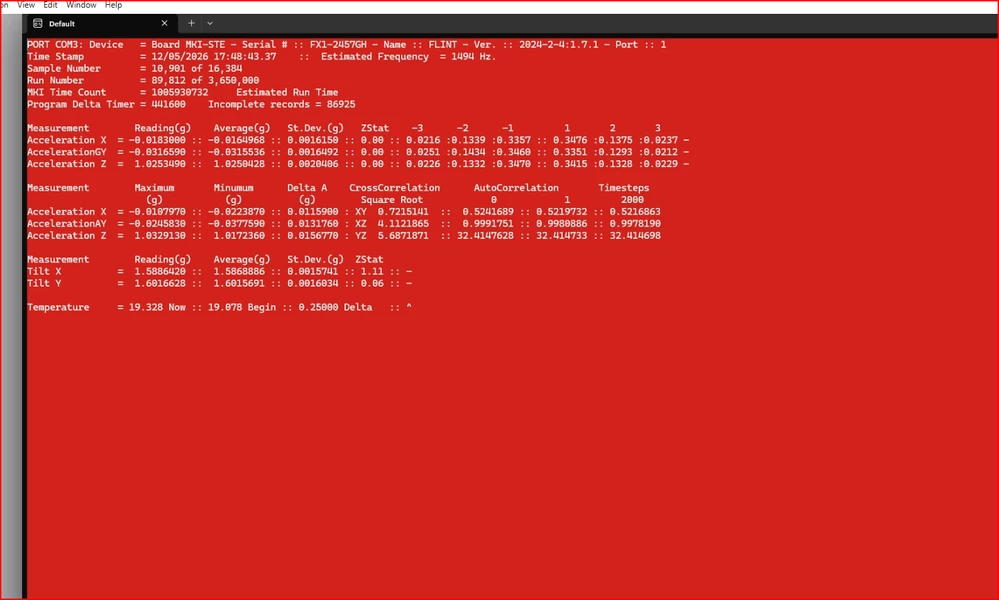
The PRO's revised program
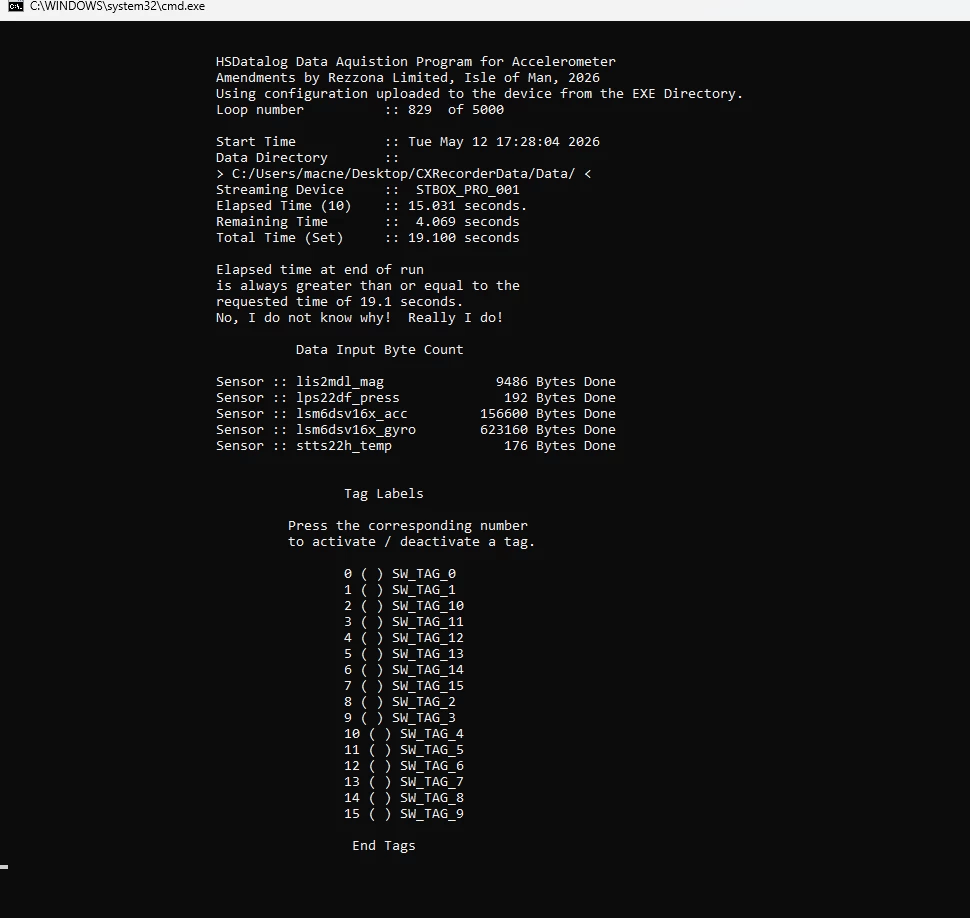
The PRO is great on a USB cable, but it is not as good as the other pair, it is much harder to program because of the C program that is mostly locked. Of course they are sales toys for ST but for us they are mission critical devices. Put up the C code for the dll's and allow us to use MSVS and not g++. I gave up make type files in 1988.
PS Captain Flint is named for the uncle in the Arthur Ransome Book, Swallows and Amazons, which is an excellent read for children and has a lot of scientific method and unstructured play in it.