Associate
May 4, 2026
Question

LSM6DSV16X pitch/roll signal anomaly

  • May 4, 2026
  • 4 replies
  • 401 views

Hi,

We are using a LSM6DSV16X unit to track pitch and roll in our product based on the quaternions reported by the unit's SFLP algorithm (High Accuracy ODR 120Hz)

During the operation and in what seem to be arbitrary times, the pitch and roll signals for such unit present some unexpected overshoot or oscillation (see below) before returning to the expected value.
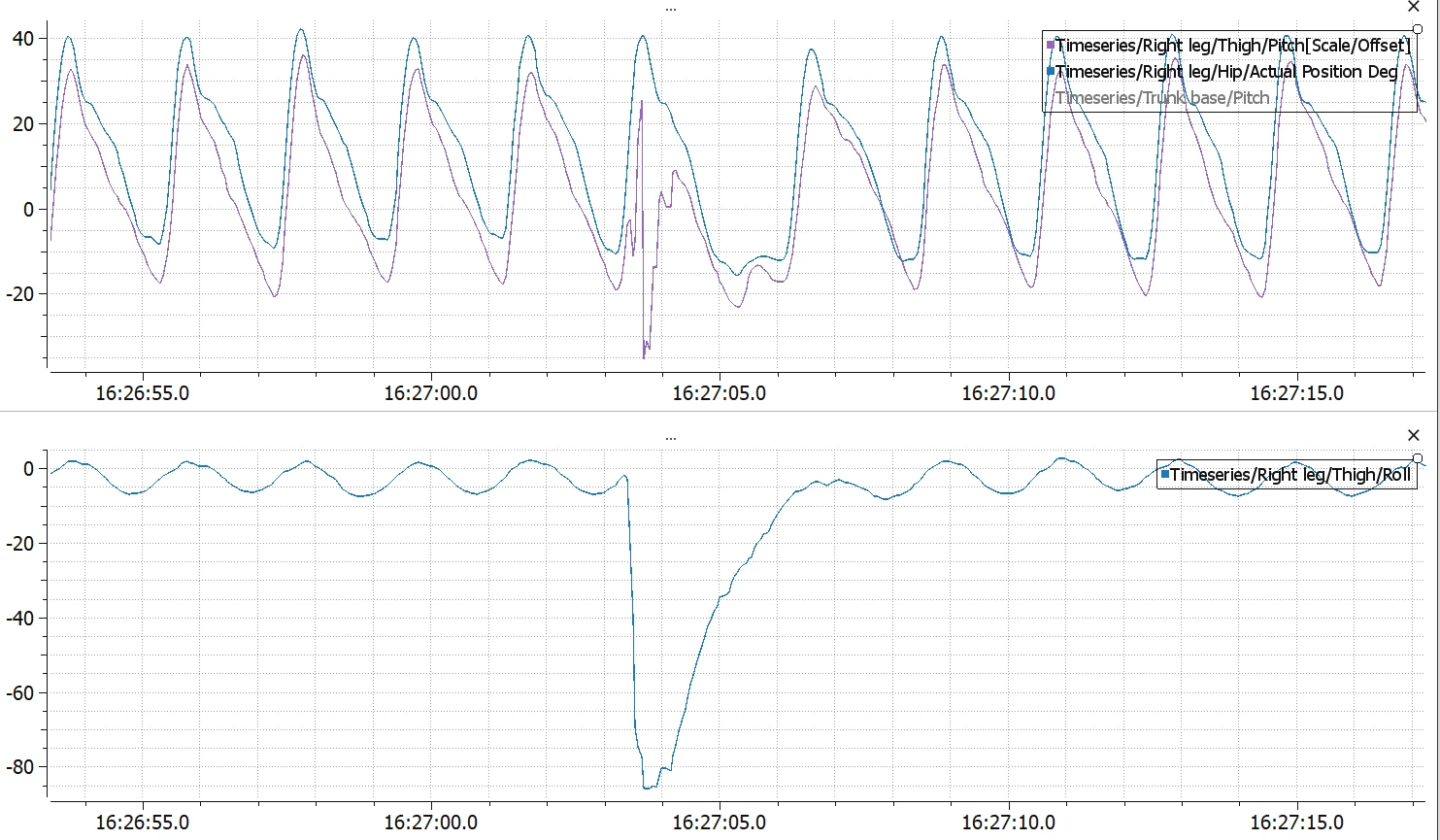
145018_RightLeg_IMU_error_roll_detail.PNG

The graph above shows the IMU pitch signal (purple) with the reading of an absolute encoder (blue) and both signals should be fairly similar. The roll signal below, although not compared to any other signal, should maintain the same oscilatory behavior that is seen before and after the anomaly (vertical axis in º). At the moment of the anomaly, no special movement happened that could have caused such readings.

We have other LSM6DSV16X units in the same usecase and we do not see such behavior as of now.

We were doubting whether this could be a calibration problem of the IMU? Is there any calibration procedure you recommend for these IMU units?

Could this maybe be somehow related to the limitation in the quaternion components variables stored in half precision floats? https://community.st.com/t5/mems-sensors/lsm6dsv-half-precision-error-at-180-degrees/td-p/628771

Thank you in advance,

Joan

4 replies

Associate III
May 4, 2026

You may have an input from another machine or human in the environment.  If it does not repeat I would suggest that it is the likely cause.  If it repeats then look for external signal first.  

In the Smithsonian it is a railway tunnel, in London it is a railway subway and in Italy it was a 35 Hz motor.  

On a desk it can be a hard drive rotation.  

Just a few thoughts, but I would blame the instrument last.  


JoanVAuthor
Associate
May 5, 2026

Hi Smithson,

Thank you for your help!

We will keep in an eye for external signals that could cause this disturbance on the IMU signals.


In any case, we are interested to know if there is any calibration procedure recommended for the accelerometer and gyroscope of the LSM6DSV16X IMU. 


Thank you in advance!

Joan

Associate III
May 5, 2026

Based on the response you are getting so far, I would hazard no.  

I am using the same device in the Sensor TileBox Pro, I cannot think of a physics test for calibration that would work. 

Nothing could hold it still enough, now statistically maybe, but it would be hard and time expensive.  

Smithson_0-1778004625782.png

Kappler provides an interesting discussion on the problem.  

JoanVAuthor
Associate
May 7, 2026

Hi Smithson,

Thanks again for your answers. 

We are mostly interested in whether there was a calibration routine that ST recommended for such IMU model that could be done relatively easy (a flag that could be checked for calibration completeness, position the IMU in different orientations to allow for better self calibration, ...)

We've conducted more tests and could see that external mechanical disturbance do create pitch and roll anomalies in the IMU. The anomaly seems to come from the quaternion components coming from the SFLP algorithm. However, we've tested other units in the same conditions and do not show the same behavior, being their signals consistent with the expected values.

We've also run the inbuilt selftest for the IMU that is showing signal anomalies and it passed successfully. Nonetheless, since the IMU showing anomalies seems to be a particular case within the set of IMUs tested, we are inclined to think it is an issue with that particular unit.

We will continue to investigate though.

If you or anyone else might have other calibration suggestions or has observed similar behavior, we would like to hear it:)

Joan


Associate III
May 7, 2026

The Sensor Tile Box Pro I have is returning incorrect temperature, so I understand the pain. 

I have three more devices in London, but it is a long way away.  

Good hunting.  

Visitor II
May 10, 2026

Same happened to me. Doing custom made drone with stm32f405 ,+ this gyro.

After 24 minutes of work some oscillations appears randomly

1000065472.jpg

Associate III
May 10, 2026

If I was in a lab and saw that signal I would go look for who has turned something on.  

We can pick up the electrical signal to 300 Hz range.  

If you have the signal do a FFT and look for the frequency and then check your equipment.  


Visitor II
May 11, 2026

This bug is reproducible each time in the field. Flying 24 minutes and this happens. Logger shows random spikes during ~3-6 ms. And then it goes to normal stage. But drone during this 3-6 simply enable safe mode and falling down. Looks like something wrong with internal counters.

JoanVAuthor
Associate
May 12, 2026

Hi,


I am posting the last results we got from a test we did comparing two units of the LSM6DSV16X IMU.

Note that the IMU measurements are done simultaneously on both IMUs.

From the data, it is clear that the gyro sensor mounted on the right side is not working properly, as it shows sudden spikes of 400 deg/s.

@Smithson If this spike were to come from an external source, we would see these spikes on both IMU sensors.


It is annoying that the embedded self-test feature is not able to detect that this IMU unit is not working properly :(


JoanV_0-1778581147485.png


Associate III
May 12, 2026

Screenshot 2026-05-12 083730.png

My suggestion is to put the four circled signal in CSV format and upload them here.  Your issue does not appear Random, but I am only a pure mathematician who was led astray by the lure of money.  

PS Who is the dude who changes and moves posts? 

Visitor II
May 13, 2026

I yave similar pulses from 10-12 deg/s by Pitch up to 444 deg/sec just for few ms and slowly down during next 2-3 ms for normal 10-12.

Definitely some bugs. Can be filtered but this is wrong way.