
Lingjun Kong
Associate III
July 28, 2017
Solved

Why sometimes the Heap Pointer will be pointed to 0x000000?

  • July 28, 2017
  • 3 replies
  • 4110 views
Posted on July 28, 2017 at 18:16

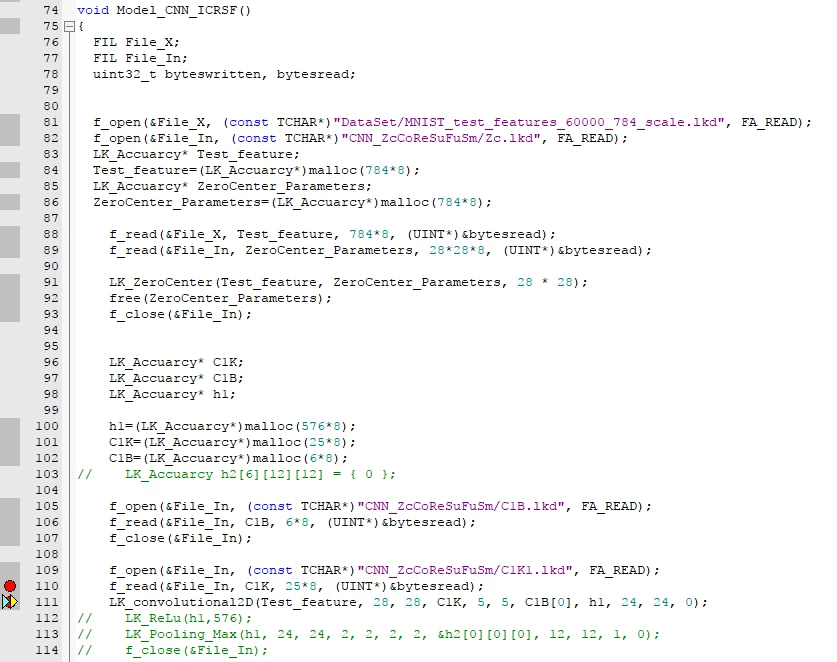
in my function, several heap pointers are defined like this
0690X00000607iTQAQ.png

when I comment the 111 line. the whole code works well. But when I add this line, the pointer Test_feature, ZeroCenter_Parameters, C1K,C1B will all, or sometimes partly, point to 0x000000.

eventually in 2 debug with the same code, it may different.

so the Question is:

In general, What will let the Heap pointer point to 0x00000? before free.

for my observation, the heap size is enough on my project (HEAP SIZE=0x8000, the same as stack size). I'm using STM32F746NG-Discovery Board so the RAM Space(at least 240KB for algorithm) is also enough. So it may be the problem of the IDE or Compiler?

My environment:

   KeilV523, STM32F746NG-Disco, Win10 Edu.

for more general situation. this code.

void heaptest()

{

int *a;

a=(int*)malloc(1024*4);

int i=1024;

while(i--)

{

*a=i;

//printf(''%d'',*a);

a++;

}

free(a);

}

0x08004468 BD10      POP           {r4,pc}

   176:         a=(int*)malloc(1024*4);

   177:         

0x0800446A F44F5080  MOV           r0,&sharp0x1000

   174: {

   175:         int *a;

   176:         a=(int*)malloc(1024*4);

   177:         

0x0800446E B510      PUSH          {r4,lr}

0x08004470 F000F8B6  BL.W          malloc (0x080045E0)

   178:         int i=1024;

0x08004474 F44F6180  MOV           r1,&sharp0x400

   179:         while(i--)

   180:         {

   181:                 

0x08004478 E000      B             0x0800447C

   182:                 *a=i;

   183:                 //printf(''%d'',*a);

   184:                 a++;

   185:         }

   186: 

0x0800447A C002      STM           r0!,{r1}

0x0800447C 1E49      SUBS          r1,r1,&sharp1

0x0800447E D2FC      BCS           0x0800447A

   187:                 free(a);

   188: }

   189: int main(void)

   190: {

   191:   SCB_EnableICache();

   192:   SCB_EnableDCache();

0x08004480 E8BD4010  POP           {r4,lr}

0x08004484 F7FFBF08  B.W           free (0x08004298)

before the free operation, the pointer will be pointed to 0x00000. who did that?

#c #stm32f7 #heap #c/c+ #memory #keil #c++ #keil-ide #!stm32-!heap-!sdram-!malloc
This topic has been closed for replies.
Best answer by Tesla DeLorean
Posted on July 28, 2017 at 21:02

h1=(double*)malloc(576*8);

memset(h1,0,578*8);

You allocate 576 units and use 578, trashing the arena.

Your free(a) example is STILL broken, you can't advance a and pass the new pointer in.

3 replies

Tesla DeLorean
Guru
July 28, 2017
Posted on July 28, 2017 at 18:21

malloc() returns zero to indicate that the heap is out of memory.

Make the heap big enough to service your needs, see size defined in startup_stm32fxxx.s, make a localized copy in your project directory without the read-only attribute set so you can edit it.

The free() in your test case isn't being passed the pointer that was actually allocated.

Tips, Buy me a coffee, or three.. PayPal VenmoUp vote any posts that you find helpful, it shows what's working..
Lingjun Kong
Associate III
July 28, 2017
Posted on July 28, 2017 at 18:28

Thanks for your reply.

Yes, but I could confirm that my heap is already big enough. and the fact is, all the memory before the free() operation has been changed correctly. 

so, do you mean, if one pointer is over heap when it was malloced, all the others will be changed back to zero?

Tesla DeLorean
Guru
July 28, 2017
Posted on July 28, 2017 at 18:36

Calling free() with an address it didn't allocate will likely trash the memory arena.

Don't free(a += 1024);

Every time you call malloc() you need to check if it returned NULL before you attempt to use it. You should also make sure not to free(NULL). Nest your malloc/free so that failure unwinds, and doesn't compound.

>>

so, do you mean, if one pointer is over heap when it was malloced, all the others will be changed back to zero?

No, but if you take a pointer and zero memory you can trash other parts of the heap or stack if the pointer is damaged (see freeing the wrong pointer)

Tips, Buy me a coffee, or three.. PayPal VenmoUp vote any posts that you find helpful, it shows what's working..
Vangelis Fortounas
Associate II
July 28, 2017
Posted on July 28, 2017 at 20:57

Hello!.

In function scope, every allocation with malloc (and using a local pointer) Must terminated with free(the valid pointer) before the function returns! its mandatory.

In any other case the memory will never been deallocated , until restart the program (almost like this).

Every time you call a function with 'memory leak' issue, the heap free memory decreases until all allocation functions return zero!

Daniel Glasser
Associate III
July 31, 2017
Posted on July 31, 2017 at 22:13

As several people have tried to point out, the increment of the pointer 'a' in the loop changes it so that it can not be used in a call to 'free()'.

void heaptest()

{

int *a;

a=(int*)malloc(1024*4);

int i=1024;

while(i--)

{

*a=i;

//printf('%d',*a);

a++;

}

free(a);

}

Emphasis mine.  This could be rewritten as:

void heaptest(void)

{

  int* chunk = (int*)malloc(1024 * sizeof(int));

  if (chunk != NULL)

  {

    int* a = chunk;

    int i = 1024;

    while (i--)

    {

      *a = i;

      // printf('%d,\n', *a);

      a++; 

    } 

    free(chunk);

  }

}

I added a newline to the end of the format string in the commented out 'printf()' call.