  • 5 Product updates

High-voltage power stage with space-efficient evaluation board for smaller, tougher motor drives

High-voltage power stage with space-efficient evaluation board for smaller, tougher motor drives

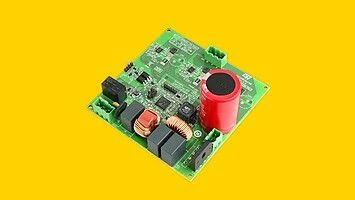
Accelerating development of compact and reliable fans and pumps built with energy-efficient motors, STMicroelectronics has introduced the PWD5T60 three-phase driver with a ready-to-use evaluation board that supports flexible control strategies.Suited to applications up to 500V, the PWD5T60 integrates a gate driver and six power MOSFETs with RDS(ON) of 1.38Ω, enabling the device to achieve an outstanding energy to area rating. Zero-drop bootstrap diodes are also built-in, requiring minimal external components to complete the circuit in only 30% of the board area of an equivalent driver built with discrete components. The propagation delays of high-side and low-side MOSFETs are closely matched, which eliminates cycle distortion and maximizes flexibility to set the operating frequency for optimum response and energy efficiency.The EVLPWD-FAN-PUMP evaluation board, released at the same time, helps developers quickly explore the value this driver can deliver in projects up to 100W. The board combines the PWD5T60 with an STM32G0 microcontroller (MCU) that can handle field-oriented control (FOC) or 6-step control of permanent magnet synchronous motors (PMSMs) and brushless DC (BLDC) motors. With configurable single or three-shunt sensing and leveraging the PWD5T60’s high feature integration to achieve a compact, circular form factor, the board is optimized for use with fans and pumps. The board also features a power-supply stage to generate 12V and 3.3V supply voltages for the application and comes with a complete AC line filter at the input.Featuring on-board bus-voltage sensing, the EVLPWD-FAN-PUMP board helps utilize the PWD5T60’s safe design that provides undervoltage lockout (UVLO) for each bootstrap section to prevent operation in dangerous or low-efficiency conditions. Engineered for robustness, the PWD5T60 also features cross-conduction prevention with interlocking and pre-programmed default deadtime to ensure failsafe protection against shoot-through currents. In addition, excellent below-ground robustness ensures faultless performance.The PWD5T60 has a smart shutdown feature that uses a comparator for fast-acting overcurrent prevention. The output turns off immediately when a fault is detected, while the subsequent output-disable duration is programmed by connecting a capacitor and optional pull-up resistor to a dedicated pin. The turnoff response is unaffected by these components, letting product developers optimize the duration to allow time for faults to clear while always ensuring instant turn-off.The driver has a wide input supply voltage range from 9V to 20V for optimum flexibility, while CMOS/TTL-compatible logic inputs down to 3.3V simplify interfacing with a host controller.The PWD5T60 is in full production and available in a compact 12mm x 12mm VFQFPN package only 0.95mm high, from $3.28 for orders of 1000 pieces.The EVLPWD-FAN-PUMP evaluation board is available now from the eSTore, at the budgetary price of $102.00. The board delivers plug-and-play convenience leveraging FOC and 6-step control firmware in the X-CUBE-MCSDK motor-control software development kit available free of charge at st.com.Additional resourcePWD5T60 product overviewFirst published on Sep 18, 2024

Related products:STM32 MCUs
STM32Cube further facilitates code development with Clang/LLVM support

STM32Cube further facilitates code development with Clang/LLVM support

Clang/LLVM toolchain project overviewFor over a decade ST has offered GNU tools for STM32 as the free, reference toolchain when developing STM32 applications. It is well supported across the complete STM32Cube ecosystem and will continue to be maintained by ST.The Clang/LLVM toolchain will over time offer STM32 developers better code density and execution speed. This release is a first step on the journey towards better toolchain performance and increased STM32Cube ecosystem integration. The toolchain will be supported within STM32CubeMX and with STM32Cube for Visual Studio Code.This release provides a first version of the ST Arm Clang toolchain built on the Arm LLVM source tree. It allows early adopters to try a toolchain with a similar performance compared to today’s GCC. It offers more sanity checkers, more optimized C libraries, while compiler benchmark figures will come later.Further to this initial release, developers can expect two additional steps:Feedback collection   Early adopters will be provided the opportunity to share feedback, allowing ST to finetune the toolchain and ensure its level of integration across the STM32Cube ecosystem meets expectations. Toolchain optimization  ST will adjust the toolchain with the aim to improve code density and execution speed.Embracing a step-by-step approach ensures that we set priorities in the development phase, in accordance with developer feedback. The ST Arm Clang flavor will soon provide example projects, and STM32CubeMX and STM32Cube for Visual Studio Code will help STM32 developers get started in the meantime. What the ST Arm Clang toolchain offersST Arm Clang is a new C/C++ toolchain for STM32 development, which is built on the modern LLVM compiler infrastructure and the Arm Toolchain for Embedded.This new LLVM-based toolchain provides developers with a more efficient, flexible, and future-proof development environment while maintaining compatibility with existing projects.ST Arm Clang is designed as a drop-in replacement for the GNU tools for STM32, minimizing disruption for developers transitioning to it. However, several minor incompatibilities or divergent features may exist due to the differences in the underlying infrastructure. To ease this transition, we provide two versions of the toolchain:Hybrid toolchain: only the C/C++ LLVM Clang compiler and the integrated assembler are used to compile the code into object files (local applications, HAL, etc.). The final binary is built using the tools and libraries from the existing GNU tools for STM32 (GNU Binutils linker, C/C++ libraries, and runtime). This hybrid version is ideal for developers looking to test or leverage Clang's compilation while retaining the familiar GNU linking and runtime environment. Both toolchains (Clang and GCC) should be installed on your system, and link-time optimization (LTO) is not available in this mode. Full LLVM toolchain: this version offers the complete long-term LLVM-based solution (Clang compiler, LLVM linker and runtime) with updated libraries, such as Picolibc or LLVM libc++. It benefits from the combined effort from the LLVM community, as well as Arm and ST research and development teams to reach optimal support, performance, and code-size on STM32 devices. The toolchain offers two distinct C library implementations, allowing developers to choose based on their project priorities or device resources: Newlib for performance and Picolibc for code size.STM32CubeMX support The STM32CubeMX version 6.15 introduces support for ST Arm Clang. More specifically, STM32CubeMX generates projects for the hybrid flavor of the ST Arm Clang toolchain. This will allow STM32 developers to quickly try their existing GCC projects with ST Arm Clang toolchain without having to write a new linker script or consider incompatibilities between Newlib and Picolibc. Selecting the combination of CMake and ST Arm Clang will create a project targeting the hybrid toolchain:If users wish to switch from the hybrid to the full LLVM flavor, they can do so inside STM32Cube for Visual Studio Code , following the explanations below.STM32Cube for Visual Studio CodeDevelopers can choose between two options to start a project within the STM32Cube ecosystem.Use STM32CubeMX to generate a configurable project Use STM32Cube for Visual Studio Code to generate an empty projectThis tutorial is based on the assumption that a project was created with STM32CubeMX as shown in the previous chapter.

Related products:STM32 MPUs
STPay-Topaz-2 next-generation contactless-payment solution boosts flexibility and security

STPay-Topaz-2 next-generation contactless-payment solution boosts flexibility and security

STMicroelectronics has unveiled STPay-Topaz-2, its next-generation contactless payment card system-on-chip (SoC), offering more flexibility to support a wider variety of payment brands and ease stock management for customers. The new auto-tuning feature ensures reader-independent connection quality for an enhanced user experience, while advanced cryptography strengthens security and prepares the platform for upcoming, stronger industry standards.ST has already supplied more than three billion STPay ready-to-use solutions to the payment market. STPay-Topaz-2 now introduces a specific feature which allows preloading the greatest quantity of payment applets per orderable part number in the market, which simplifies inventory management for card manufacturers. This innovation includes a unique product versioning which embeds the latest and most popular payment applets worldwide, including both VSDC2.8.1g1 and 2.9.2 Visa applets.“Contactless payment has been a huge hit with consumers and the technology must now move forward as card suppliers strive to meet growing customer demand and more diverse market requirements,” said Bruno Batut, Banking & ID Business Unit Marketing Director, Connected Security Division, STMicroelectronics. “STPay-Topaz-2 can consolidate the largest set of payment apps on one orderable part number to simplify inventory management for card manufacturers, paving the way for further expansion in contactless payment popularity. We’ve also added auto-tuning to ensure the best tap-anywhere user experience and upgraded security ready for future standards including the forthcoming EMVCo C-8 kernel.”The STPay-Topaz-2 is based on the ST31R480 secure microcontroller (MCU), manufactured in ST’s secure and certified facilities in France. The secure MCU achieved EMVCo certification in November 2024 and recently completed Common Criteria EAL6+ certification.This STPay solution is ready for the payment industry’s adoption of stronger digital security, ranging from RSA/3DES encryption to advanced encryption standard (AES) and elliptic curve cryptography (ECC): it is designed to comply with the forthcoming EMVCo C 8 kernel. The platform also meets GlobalPlatform and Java Card standards, making it suitable for payments, loyalty programs, and custom applications.With enhanced wireless performance, STPay-Topaz-2 also simplifies antenna integration for card manufacturers and enables efficient connectivity even with smaller antennas, providing greater design flexibility.STPay-Topaz-2 samples are available immediately, with production already launched.For pricing and sample requests, contact your local STMicroelectronics sales office.

Related products:
New industrial-grade accelerometer with edge AI and low power for smart sensing

New industrial-grade accelerometer with edge AI and low power for smart sensing

STMicroelectronics’ IIS2DULPX industrial MEMS accelerometer combines machine learning, power saving, and capability to operate at high-temperature, facilitating intensive sensorization for smarter, data-driven operations and decision making in asset tracking, robotics, and factory automation, as well as industrial-safety equipment and healthcare devices.With in-sensor AI to relieve the host processor and automatic self-configuration to optimize power consumption, the IIS2DULPX lets equipment makers build maintenance-free, battery-powered smart sensor nodes in convenient form factors. “Our new IIS2DULPX accelerometer uniquely combines edge processing with ultra-low-power consumption and extended operating temperature range for the next generation of smart industrial sensors,” said Tarik Souibes, MEMS sub-group marketing director, STMicroelectronics. “With their on-chip intelligence, these accelerometers operate and adapt in real time to context, giving flexibility to adopt a deterministic algorithm or AI approach as best suited to the application.”Typical applications for the new accelerometer include event tracking of assets or goods in transit. ST’s machine-learning core (MLC) can host AI algorithms to classify the kind of transportation system the asset is on and the events such as dropping, shaking, tilting, and flipping, enhancing quality assurance and supply-chain process improvement. Performing inference directly in the sensor relieves demands on the host-processor thus helping greatly extend the sensor battery life.In addition, the IIS2DULPX is used in sensors for smart condition monitoring that are attached to assets such as industrial machinery or robotic arms to detect excessive vibrations, hits, and shocks . Here, small size and ultra-low power consumption let device makers create sensors with a compact outline and extended operation from a small and lightweight battery, that can be easily used to retrofit equipment that is already installed and operational. End users can thus instantly start collecting data from any equipment, including legacy machinery, to accelerate and extend their digital transformation initiatives.Among ST’s early customers, Treon has recently developed a smart condition-monitoring system containing the new sensor. “We have just launched the Treon Industrial Node X, our long-lasting wireless condition-monitoring system, featuring the IIS2DULPX accelerometer, which we chose for its exceptional ultra-low power performance,” said Joni Korppi, CEO at Treon. “The intelligence embedded in this sensor enables the entire system to operate at extremely low power, achieving the battery duration we need. Moreover, its 10-year guaranteed market availability aligns perfectly with our product lifecycle requirements.” In the Treon system, the IIS2DULPX accelerometer performs continuous monitoring of vibration levels with ultra-low power consumption, working in conjunction with an ST IIS3DWB high-performance vibration sensor to react to changes in vibration level and trigger more detailed measurements."With the Treon Industrial Node X, we have set a new standard in efficient, reliable, and long-lasting condition-monitoring solutions leveraging ST’s innovative MEMS sensors,” added Korppi.Further applications for the IIS2DULPX include smart protective equipment and portable healthcare devices, including monitoring systems designed into industrial safety helmets to detect proper helmet wearing, impacts and falls for accident prevention or prompt emergency alerts, improving overall workplace safety. The sensor can detect a dangerous fall and immediately generate an alert for prompt assistance, as well as monitoring activity to identify unusual work patterns and ensure safety compliance. With its embedded machine-learning core and finite state machine (MLC/FSM), as well as automatic self-configuration, the IIS2DULPX permits continuous supervision while consuming very little energy, enabling a simple battery-operated accessory to transform a conventional safety helmet into a smart helmet.The IIS2DULPX has also been integrated in an advanced battery-powered sensor for monitoring wafer-handling robot arms in semiconductor fabrication, to measure vibrations and shocks that could impact yield or reliability of chips. The accelerometer’s embedded MLC and automatic self-configuration let the battery-operated sensor node provide accurate and continuous monitoring, maintenance-free, for more than three years.The IIS2DULPX operates over an extended operating temperature range, up to 105°C. It is available now, priced from $1.57 for orders of 1000 pieces.

Related products:STM32 MCUsSTM32 MPUs
Navigate new EU security regulations with ST solutions

Navigate new EU security regulations with ST solutions

Security is now a core part of product development. The EU’s Cyber Resilience Act (CRA) and Radio Equipment Directive (RED) have set mandatory cybersecurity and safety standards for connected digital and radio devices.The CRA is a new EU law requiring connected digital products to meet strict cybersecurity standards throughout their lifecycle, protecting users and reducing cyber risks.The RED is an EU regulation ensuring radio and telecom devices are safe, free from harmful interference, and equipped with essential security features for reliable wireless communication.As developers, integrating these requirements early helps build secure, reliable products that protect users, avoid costly penalties, and maintain market access.These regulations are designed to close security gaps early in the product lifecycle, ensuring devices are secure by design, regularly updated, and capable of resisting attacks. Non-compliance not only risks user safety and data integrity but can also lead to costly penalties and market access restrictions.Key reasons to prioritize CRA and RED regulationsBuild devices for the long term: security is now mandatory and will bear further requirements in the future. Protect users and data: prevent cyberattacks, unauthorized access, and data breaches by embedding security early and maintaining it throughout the product lifecycle. Protect your market and bring confidence: meet high security and safety standards to earn customer trust and ensure your products remain competitive in the European market. Avoid risks and penalties: stay ahead of regulatory requirements to prevent product recalls, fines, and legal liabilities. Reduce costs of non-security: adopt secure-by-design principles that reduce vulnerabilities and future-proof your products.How ST helps you achieve complianceST integrates cybersecurity deeply into its product design and manufacturing processes, and embedded software, offering a comprehensive portfolio of security features aligned with CRA and RED requirements:Certified security solutions: ST products come with certifications like SESIP (EN 17927:2023) and PSA and have a background of process certification such as ISO 21434, Common Criteria, and others, demonstrating compliance readiness. Vulnerability management: ST maintains transparent vulnerability disclosure and mitigation processes compliant with international standards (ISO/IEC 29147, 30111). Secure development lifecycle: ST promotes secure boot, firmware updates, cryptographic accelerators, and hardware tamper protections to ensure device integrity and confidentiality. Support and ecosystem: through STM32Trust and partner networks, ST provides tools, frameworks, and guidance to implement robust security measures tailored to product risk profiles. Long-term security support: ST commits to extended security update availability, helping customers meet CRA’s mandatory support periods.By leveraging ST’s proven security expertise and solutions, you can confidently build compliant, secure products that protect users and maintain market access.

Related products:STM32 MCUs