SPI External Loader Error for STM32G491KCU6
I need to use an external loader via single SPI for a project. Despite performing all the necessary steps. I'm getting an error through CubeProgrammmer.
/* Entry Point */
ENTRY(Init)

/* Generate 2 segment for Loader code and device info */
PHDRS {Loader PT_LOAD ; SgInfo PT_LOAD ; }

/* Highest address of the user mode stack */
_estack = ORIGIN(RAM) + LENGTH(RAM); /* end of RAM */
/* Generate a link error if heap and stack don't fit into RAM */
_Min_Heap_Size = 0x200; /* required amount of heap */
_Min_Stack_Size = 0x400; /* required amount of stack */

/* Specify the memory areas */
MEMORY
{
RAM (xrw) : ORIGIN = 0x20000004, LENGTH = 112K-4
}

/* Define output sections */
SECTIONS
{
 /* The startup code goes first into FLASH */

 .isr_vector :
 {
 	. = . + 0x1FC;
 . = ALIGN(4);
 KEEP(*(.isr_vector)) /* Startup code */
 . = ALIGN(4);
 } >RAM :Loader


 .ARM.extab : { *(.ARM.extab* .gnu.linkonce.armextab.*) } >RAM
 .ARM : {
 __exidx_start = .;
 *(.ARM.exidx*)
 __exidx_end = .;
 } >RAM :Loader

 .preinit_array :
 {
 PROVIDE_HIDDEN (__preinit_array_start = .);
 KEEP (*(.preinit_array*))
 PROVIDE_HIDDEN (__preinit_array_end = .);
 } >RAM :Loader

 .init_array :
 {
 PROVIDE_HIDDEN (__init_array_start = .);
 KEEP (*(SORT(.init_array.*)))
 KEEP (*(.init_array*))
 PROVIDE_HIDDEN (__init_array_end = .);
 } >RAM :Loader

 .fini_array :
 {
 PROVIDE_HIDDEN (__fini_array_start = .);
 KEEP (*(SORT(.fini_array.*)))
 KEEP (*(.fini_array*))
 PROVIDE_HIDDEN (__fini_array_end = .);
 } >RAM :Loader

 /* used by the startup to initialize data */
 _sidata = LOADADDR(.data);

 /* Initialized data sections goes into RAM, load LMA copy after code */
 .data :
 {
 . = ALIGN(4);
 _sdata = .; /* create a global symbol at data start */
 *(.data) /* .data sections */
 *(.data*) /* .data* sections */

 . = ALIGN(4);
 _edata = .; /* define a global symbol at data end */
 } >RAM :Loader


 /* Uninitialized data section */
 . = ALIGN(4);
 .bss :
 {
 /* This is used by the startup in order to initialize the .bss secion */
 _sbss = .; /* define a global symbol at bss start */
 __bss_start__ = _sbss;
 *(.bss)
 *(.bss*)
 *(COMMON)

 . = ALIGN(4);
 _ebss = .; /* define a global symbol at bss end */
 __bss_end__ = _ebss;
 } >RAM :Loader

 /* The program code and other data goes into FLASH */
 .text :
 {
 . = ALIGN(4);
 *(.text) /* .text sections (code) */
 *(.text*) /* .text* sections (code) */
 *(.glue_7) /* glue arm to thumb code */
 *(.glue_7t) /* glue thumb to arm code */
 *(.eh_frame)

 KEEP (*(.init))
 KEEP (*(.fini))

 . = ALIGN(4);
 _etext = .; /* define a global symbols at end of code */
 } >RAM :Loader

 .Dev_info :
 {
	KEEP(*Dev_Inf.o ( .rodata* ))
 } :SgInfo


 /* Constant data goes into FLASH */
 .rodata :
 {
 . = ALIGN(4);
 *(.rodata) /* .rodata sections (constants, strings, etc.) */
 *(.rodata*) /* .rodata* sections (constants, strings, etc.) */
 . = ALIGN(4);
 } >RAM :Loader


 /* User_heap_stack section, used to check that there is enough RAM left */
 ._user_heap_stack :
 {
 . = ALIGN(4);
 PROVIDE ( end = . );
 PROVIDE ( _end = . );
 . = . + _Min_Heap_Size;
 . = . + _Min_Stack_Size;
 . = ALIGN(4);
 } >RAM :Loader


 .ARM.attributes 0 : { *(.ARM.attributes) }
}
My linker code is above. I also generate .stldr file.
#include "Dev_Inf.h"

/* This structure containes information used by ST-LINK Utility to program and erase the device */
#if defined (__ICCARM__)
__root struct StorageInfo const StorageInfo = {
#else
struct StorageInfo __attribute__((section(".Dev_info"))) /*const*/ StorageInfo = {
#endif
 "W25Q64JVZPIQ-STM32G491-EXT-FLASH", 	 	// Device Name + EVAL Borad name
 SPI_FLASH, 					// Device Type
 0x00000000, 						// Device Start Address
 0x00800000, 						// Device Size in Bytes (8MBytes)
 0x100, 						 // Programming Page Size 256Bytes
 0xFF, 						// Initial Content of Erased Memory
// Specify Size and Address of Sectors (view example below)
 {
 {0x00000800, 0x00001000}, 		 // Sector Num : 2048 ,Sector Size: 4KBytes
 {0x00000000, 0x00000000}
 }
};
My dev_inf function is as shown above. I'm using W25Q64 as an external flash. The flash drive is working correctly without external loader. It has been tested before.
int Init(void)
{

 SystemInit();
 /* ADAPTATION TO THE DEVICE
 *
 * change VTOR setting for H7 device
 * SCB->VTOR = 0x24000000 | 0x200;
 *
 * change VTOR setting for other devices
 * SCB->VTOR = 0x20000000 | 0x200;
 *
 * */
 SCB->VTOR = 0x20000000 | 0x200;


 HAL_DeInit();
 HAL_Init();

 /* Configure the system clock */
 SystemClock_Config();

 /* Initialize all configured peripherals */
 MX_GPIO_Init();
 MX_SPI3_Init();


 __HAL_SPI_ENABLE(&hspi3);

 __set_PRIMASK(0); //enable interrupts
 __set_PRIMASK(1); //disable interrupts

 return LOADER_OK;
}
I'm trying to initialize an external loader using the Init() function above. I have also read, write, sector erase and other functions.
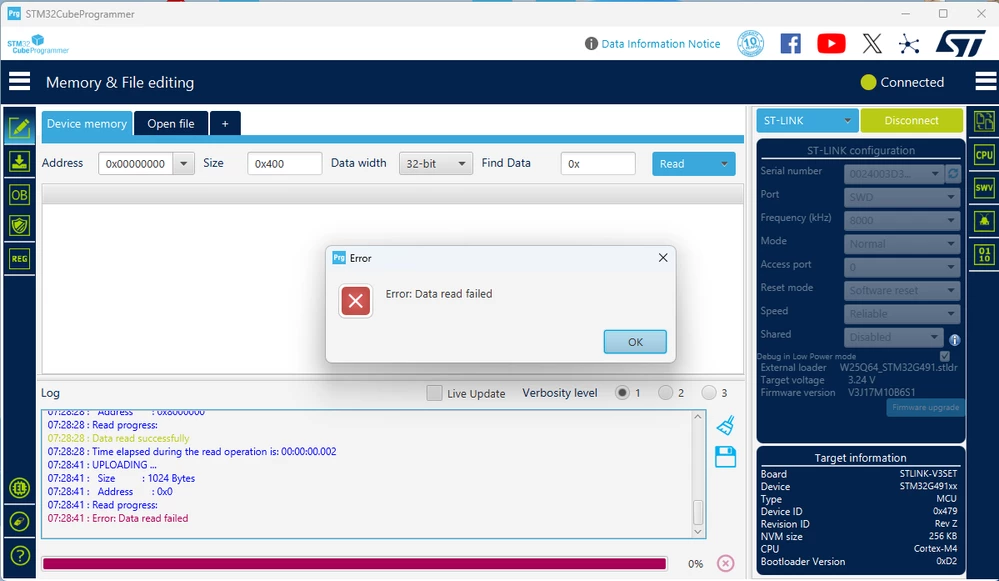
I can't read and write to start address. As you see at image, I have an error. Loader was selected by the way.
int Read (uint32_t Address, uint32_t Size, uint8_t* Buffer)
{
// sFLASH_ReadBuffer(Buffer, Address, Size);

 return 1;
}
In addition, I tried Read() function above. This function at above only return 1 so, There shouldn't be any errors. But I'm still getting errors.
I need to write an external loader for my processor. I've tried many things but haven't succeeded. I would appreciate your help.