
LHuss.1
Associate II
March 16, 2024
Solved

CAN transmit acknowledged even though no receiving node.

  • March 16, 2024
  • 1 reply
  • 1403 views

I want to set up error handling for my CAN messages, and I wanted to start with errors from sending messages to IDs not on the CAN bus net. However, every message I send is acknowledged. There is only stm32 chip set up on the net and the rest are currently TMC Pandrive motors. 
I am sending messages to individual motors with different IDs without issue - they're received and the motors react accordingly. 
So I am not sure how or why these messages to other CAN IDs are acknowledged. 
Below is the code I use in my CAN interface file. 


#include <CANInterface.h>

CAN_RxHeaderTypeDef rxHeader;
CAN_TxHeaderTypeDef txHeader;
std::vector<uint8_t> canRX(7, 0);
CAN_FilterTypeDef canfil;
uint32_t canMailbox;

void HAL_CAN_RxFifo0MsgPendingCallback(CAN_HandleTypeDef *hcan1) {
	std::vector<char> sendBuf(60, 0);
	uint8_t bufLen = sprintf(sendBuf.data(), "response triggered\r\n");
	HAL_UART_Transmit(&huart5, (uint8_t *)sendBuf.data(), bufLen, 200);
	HAL_CAN_GetRxMessage(hcan1, CAN_RX_FIFO0, &rxHeader, canRX.data());
}

void sendCANMessage(uint8_t component, std::vector<uint8_t> canMessage) {
	txHeader.StdId = component;
	HAL_StatusTypeDef status = HAL_CAN_AddTxMessage(&hcan1, &txHeader, canMessage.data(), &canMailbox);
	std::vector<char> sendBuf(60, 0);
	uint8_t bufLen = sprintf(sendBuf.data(), "status: %d\r\n", status);
	HAL_UART_Transmit(&huart5, (uint8_t *)sendBuf.data(), bufLen, 200);
}

void CANSetup() {
	txHeader.DLC = 7;
	txHeader.StdId = 0x02;
	txHeader.IDE = CAN_ID_STD;
	txHeader.RTR = CAN_RTR_DATA;
	txHeader.TransmitGlobalTime = DISABLE;

	canfil.FilterFIFOAssignment = CAN_FILTER_FIFO0;
	canfil.FilterIdHigh = (1 << 5);
	canfil.FilterIdLow = 0;
	canfil.FilterMaskIdHigh = 0;
	canfil.FilterMaskIdLow = 0;
	canfil.FilterScale = CAN_FILTERSCALE_16BIT;
	canfil.FilterBank = 14;
	canfil.SlaveStartFilterBank = 0;
	canfil.FilterActivation = ENABLE;

	HAL_CAN_ConfigFilter(&hcan1, &canfil);
	HAL_CAN_Start(&hcan1);
	HAL_CAN_ActivateNotification(&hcan1, CAN_IT_RX_FIFO0_MSG_PENDING);
}
 

Best answer by mƎALLEm

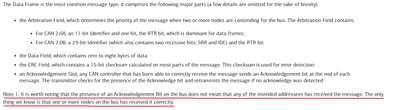
You’re not supposed to worry about the structure of the frame. The peripheral is doing it. The frame acknowledgement is performed by any node receiving the frame no matter it’s the recipient or not. The acknowledgement has no relation with the ID but with the consistency of the frame structure and fields/errors etc... This is the CAN protocol defined by Bosch and it's not related to the STM32 product.

From the link: https://www.kvaser.com/can-protocol-tutorial/

SofLit_0-1710676127768.png

Hope I answered your question.


1 reply

mƎALLEm
Technical Moderator
March 16, 2024

The frame is acknowledged by at least one node on the bus even it is not the frame recipient. The frame structure needs to be correct to be acknowledged.So what you are seeing is a normal behaviour 

To give better visibility on the answered topics, please click "Best answer" on the reply which solved your issue or answered your question.
LHuss.1
LHuss.1Author
Associate II
March 17, 2024

I am not sure how to ensure the structure is correct? 

I know that the body of the message is correct since it makes the motors react, and when I provide the ID for a motor, it only uses that one motor, and the crc must also be correct in it. So what's going wrong when I change the ID to one not existent inside the net? 

Why would that be received by a node who is not the recipient? I was under the impression the node would just ignore it if the ID is not correct.

mƎALLEm
mƎALLEmAnswer
Technical Moderator
March 17, 2024

You’re not supposed to worry about the structure of the frame. The peripheral is doing it. The frame acknowledgement is performed by any node receiving the frame no matter it’s the recipient or not. The acknowledgement has no relation with the ID but with the consistency of the frame structure and fields/errors etc... This is the CAN protocol defined by Bosch and it's not related to the STM32 product.

From the link: https://www.kvaser.com/can-protocol-tutorial/

SofLit_0-1710676127768.png

Hope I answered your question.


To give better visibility on the answered topics, please click "Best answer" on the reply which solved your issue or answered your question.