
UART trames are not good
Hello I am worcking an the P-NUCLEO-WB55 and I try to communicate with a other module with the LPUART. Seeing that I didn't have any responce to my commands, I use a scope to see the TX trame.
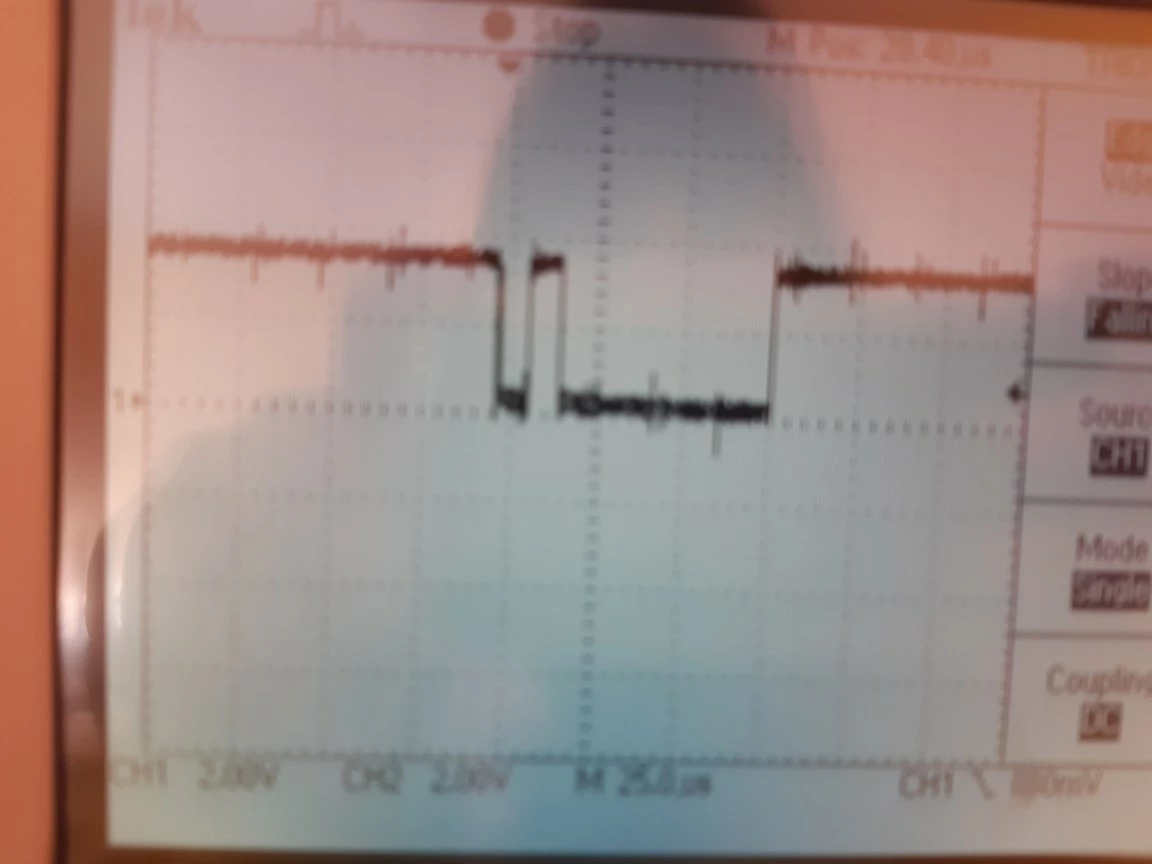 This is for example the trame of '<' (00111100) .
I used the command HAL_UART_Transmit(&hlpuart1, '<', 1, HAL_MAX_DELAY);
And there, the LPUART parameters:
static void MX_LPUART1_UART_Init(void)
{
/* USER CODE BEGIN LPUART1_Init 0 */
/* USER CODE END LPUART1_Init 0 */
/* USER CODE BEGIN LPUART1_Init 1 */
/* USER CODE END LPUART1_Init 1 */
hlpuart1.Instance = LPUART1;
hlpuart1.Init.BaudRate = 115200;
hlpuart1.Init.WordLength = UART_WORDLENGTH_8B;
hlpuart1.Init.StopBits = UART_STOPBITS_1;
hlpuart1.Init.Parity = UART_PARITY_NONE;
hlpuart1.Init.Mode = UART_MODE_TX_RX;
hlpuart1.Init.HwFlowCtl = UART_HWCONTROL_NONE;
hlpuart1.Init.OneBitSampling = UART_ONE_BIT_SAMPLE_DISABLE;
hlpuart1.Init.ClockPrescaler = UART_PRESCALER_DIV1;
hlpuart1.AdvancedInit.AdvFeatureInit = UART_ADVFEATURE_NO_INIT;
hlpuart1.FifoMode = UART_FIFOMODE_DISABLE;
if (HAL_UART_Init(&hlpuart1) != HAL_OK)
{
Error_Handler();
}
if (HAL_UARTEx_SetTxFifoThreshold(&hlpuart1, UART_TXFIFO_THRESHOLD_1_8) != HAL_OK)
{
Error_Handler();
}
if (HAL_UARTEx_SetRxFifoThreshold(&hlpuart1, UART_RXFIFO_THRESHOLD_1_8) != HAL_OK)
{
Error_Handler();
}
if (HAL_UARTEx_DisableFifoMode(&hlpuart1) != HAL_OK)
{
Error_Handler();
}
/* USER CODE BEGIN LPUART1_Init 2 */
/* USER CODE END LPUART1_Init 2 */
}
I tired to send many other caracters but I never see the good trame on the scope.
Any idea of what appened?