  • 143 articles

TouchGFX 4.25.0 now available with latest updates and fixes

TouchGFX 4.25.0 now available with latest updates and fixes

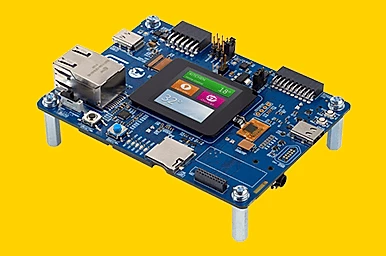
We are pleased to announce the release of TouchGFX 4.25.0, a significant update packed with new core functionalities and numerous bug fixes to enhance your development experience. Here’s a glimpse of what’s new:LTDC-driven display: emulated framebufferThis major feature introduces memory savings by using the MCU’s memory instead of external RAM. By allocating memory for only a subregion of the display and synchronizing between the LCD controller and graphics framework, full screen storage is unnecessary. This is ideal for static UIs but may require adjustments for animations to avoid screen tearing. Check out the blog article and the dedicated page in our documentation. Bitmap font compressionTouchGFX 4.25.0 introduces bitmap font compression, which can drastically reduce flash usage for applications with extensive font usage. You can enable 4Bpp bitmap font compression in the Designer under the Typography tab in the “Text” menu and configure the “Compressed Font Cache Size” in the Text Configuration Tab in the “Config” menu. Translations in external unmapped flashBuilding on our support for translations in external mapped flash, this version extends support to unmapped flash. Translations are copied into RAM for mapping. Enable this by checking “Copy translations to RAM” in the Text Configuration Tab in the “Config” menu. Improved designer performanceTouchGFX Designer now operates efficiently without a persistent internet connection, making it usable even in remote locations. Additionally, project opening and creation times have been significantly reduced, even for large projects. Simplified importing of custom containersImporting custom containers is now streamlined. If conflicts arise during import, you can select specific files to import, allowing updates to existing containers or the use of pre-existing assets. Configurable partial framebuffer block sizeYou can now configure the block dimension of your partial framebuffer, crucial for project setup. CMake supportTouchGFX now supports CMake projects. Detailed setup, build, and debug instructions are available in our documentation.Enhanced rotated display features: this will address the requests in the forum here and here.Two new features for rotated displays:Single smart framebuffer mode: now supported, resolving previous coordinate reference issues. Video support: videos with different orientations than the screen are now supported with minimal extra render time.Other features:New libraries compatible with IAR9 Libcpp (C/C++17 runtime) projectsSupport for VectorRenderer::setStrokeMiterLimit(), VectorRenderer::setStrokeLineJoin() VectorRenderer::setStrokeLineCap() functionality on NemaP and NemaPVG platformsAdded getText() to TextButtonStyleNew method HAL::InvalidateTextureCache()New hooks waitUntilTransmitEnd() and    waitUntilCanTransferBlock(uint16_t bottom) to PartialFrameBufferManager Improved render performance on NemaP and NemaPVG platforms Bugfixes:Fixed erroneous Static- and DynamicGraph code generation when named 'graph'Fixed Wipe and Cover transition on GPU2D in rotate90Fixed ToggleButton pressed and released images from presets being switchedFixed invalidated areas in Wipe and Cover transitionFixed LCD32bpp::fillBuffer when no alpha in background Fixed numeric fractions when writing RTL textFixed SVG stroke in rotated displayFixed SVG gradient in rotated displayFixed bug in translation.rb to better handle extra columns  Fixed warning in translation.rb related to document classificationsVideoconvert.rb generated old assembly syntax to include video data for Cortex-M55 on KeilFixed bug where ImageConverter would fail to generate assets if Thumbs.db files were in the asset folderFixed compiler warnings in CWRUtil::toQ5() and CWRUtil::toQ10() functionsFixed bug where ImageConverter would compress RGB images in a wrong pixel format compared to framebuffer pixel formatFixed issue with unaligned access in GeneratedFont::getPixelData()Fixed Vector Font render errorFixed issue where Texture Mappers on NemaP platforms could draw wrong pixels   Fixed bug where Graph widget did not clear correctly  To take full advantage of the features in this new version, we recommend using the last version of STM32CubeMX, STM32CubeProgrammer, and STM32CubeIDE.You can download TouchGFX 4.25.0 here (release date: 03/03/2025).First published on Mar 4, 2025


Related products:STM32 software tools
Simple, efficient, flexible 1A buck converter powers low-voltage loads in smart meters, home appliances and industrial converters

Simple, efficient, flexible 1A buck converter powers low-voltage loads in smart meters, home appliances and industrial converters

ST’s DCP3601 miniature monolithic buck converter combines extensive feature integration and flexibility, enabling simple, low-BOM designs to achieve high conversion efficiency. The power switches and compensation are built-in, requiring only six components to complete the circuit, including the inductor, bootstrap and filter capacitors, and feedback resistors for setting the output voltage. With its 3.3V-to-36V input voltage range and 1A output capability, the DCP3601 can power low-voltage loads in applications such as smart meters, domestic appliances, and industrial 24V conversion. Synchronous rectification and a fixed switching frequency of 1MHz ensure high efficiency across the load range and under all operating conditions, reaching 91% at 600mA with 12V input and 5V output. Flexibility comes from the selection of different variants, offering the choice of forced-PWM operation for noise-sensitive applications or pulse-skipping at light load for minimal power consumption. Additionally, both the low-noise and low-consumption variants are available with frequency dithering to reduce noise power at the 1MHz switching frequency. All variants have extremely low quiescent current of 110µA and an Enable pin that allows turning off the converter with a dedicated signal to maximize power savings. Designers can quickly start new projects with the DCP3601 using the dedicated evaluation board, STEVAL-3601CV1. The board comes with screw terminals and headers and is ready to power-up out of the box, demonstrating an efficient circuit design with a compact footprint. First in the new buck-converter product family that will expand throughout the year, the DCP3601 is included in ST’s 10-year longevity program that ensures long-term access to components and support. Packaged as a 3mm x 1.6mm SOT23 6-lead device, the single-chip buck converter is priced from $0.48 for orders of 1000 pieces. Additional resourcesDiscover the DCP360 series  Datasheet DCP3601 Data brief STEVAL-3601CV1First published on Feb 25, 2025

Related products:Other hardware and tools
Advanced 2-in-1 MEMS accelerometer in one IMU for intensive impact sensing in wearables and trackers

Advanced 2-in-1 MEMS accelerometer in one IMU for intensive impact sensing in wearables and trackers

16g/80g dual-range IMU with edge processing brings advanced sports monitoring to affordable wearables to “train like a pro!”. ST’s innovative LSM6DSV80X combines two accelerometer structures for 16 g and 80 g full-scale sensing, a gyroscope up 4000 dps, and embedded intelligence in a single component. Capable of measuring events ranging from slight movements to intense impacts with equal accuracy, the new sensor enables enhanced features in devices such as wearables and sports trackers. ST’s new MEMS sensor is set to redefine standards and expectations in markets for consumer and specialist wearables. By incorporating the LSM6DSV80X personal electronic devices can provide advanced capabilities such as training analysis and performance benchmarking to help athletes improve their technique. While the low-g accelerometer tracks and identifies activities like walking, running, and gesture-based interactions, high-g measurement handles energetic movements that can saturate conventional IMUs and impair accuracy. With these unique all-in-one capabilities, the LSM6DSV80X has numerous applications in sports equipment, such as monitoring performance while running or jumping. Downhill running and explosive activities like plyometrics can involve impacts over 30 g, placing high stress on knees and ankles that can now be recorded easily and cost effectively. In boxing, where impacts often exceed 60 g, athletes can now capture data using commercially available wearables empowered by LSM6DSV80X to improve strength and power, as well as detecting concussions to increase safety. Sports such as tennis can benefit from intensity impact measurements for insights to improve racquet control and acceleration for greater speed and accuracy. Alongside its advanced accelerometer architecture, the LSM6DSV80X also integrates a MEMS gyroscope and digital processing with sensor fusion low power (SFLP) technology that enables spatial orientation detection and gesture detection. In addition, ST’s machine learning core (MLC) and finite state machine (FSM) provide edge processing in the sensor to boost performance and save power. By processing the raw data locally, the IMU can recognize wearers’ activities autonomously and simplify host communications for sharper responses and lower power consumption. This permits fuller analysis of sports training, checking how accurately the athlete is performing the exercises. The sensor also features adaptive self-calibration (ASC) to adjust for different activity scenarios. Developers can find full support for the LSM6DSV80X in ST MEMS-Studio, the free graphical environment that provides tools for configuring the sensor, training the MLC decision tree, and testing. In addition, ST provides a selection of affordable evaluation boards that can host the new sensor with an adapter board, including the Professional MEMS tool (STEVAL-MKI109D) and SensorTile.box PRO (STEVAL-MKBOXPRO). Samples of the LSM60DSV80X, in a 14-pin 2.5 mm x 3 mm x 0.86 mm LGA package are available now and volume production is scheduled by the end of April 2025. Sample requests and pricing information are available from local ST sales offices. Additional resourcesProduct overview Product presentation Product page LSM6DSV80X Data brief LSM6DSV80X Blog post "LSM6DSV32X and 3 New MEMS That Vastly Improve the Performance-per-Watt Ratio" On-demand webinar "Measure and protect! Introducing the LSM6DSV32X IMU"First published on Feb 24, 2025

Related products:Other hardware and tools
Latest STM32C0 MCUs ease entry into embedded development

Latest STM32C0 MCUs ease entry into embedded development

Three new microcontrollers (MCUs) are joining the STM32C0 series, giving designers more flexibility with options including greater memory density, extended interfaces, and CAN FD for enhanced communication capability. The new MCUs now joining the cost-efficient series include the STM32C051, with up to 64 KByte of flash for applications that need more storage than STM32C031 MCUs can provide. Additional features include extra interfaces and more user I/O channels in packages with up to 48 pins. Also new, the STM32C091 and STM32C092 extend flash density up to 256 KByte in packages up to 64 pins, adding a CAN FD interface in the STM32C092. With CAN FD on-chip, users can trim the BOM and simplify the hardware design of industrial communication and networking devices, leveraging the upgraded protocol’s flexibility, speed, and payload capacity.  "The STM32C0 series offers great flexibility as a cost-conscious line in the STM32 family, with memory ranging from 32 KByte to 256 KByte of flash and rich peripherals," commented Patrick Aidoune, General Purpose MCU Division General Manager, STMicroelectronics. "The large flash and RAM now available in the STM32C091/C092 let designers host the graphical user interface alongside the main application, leveraging ST’s TouchGFX tools to create entertaining experiences and streamline development." As the most affordable entry point to the STM32 family, STM32C0 MCUs contain widely used interfaces such as crystal-less USB Full Speed Device and USARTs, as well as timers and an analog/digital; converter (ADC). Complementing the cost-conscious feature set, the economical design with on-chip clocks and just one power-supply input saves additional external components including timing and decoupling from the bill of materials (BOM). Further, these savings enable a smaller, simpler PCB design.All STM32C0 MCUs come with extra benefits for developers, including ST’s extended longevity program that ensures long-term availability throughout the lifetime of industrial projects. As members of the high-quality STM32 family, designing with STM32C0 MCUs also eases compliance with product-level approvals such as IEC 61508 for functional safety. The devices contain the Arm® Cortex®-M0+ core that also powers STM32G0 MCUs, which are designed for higher performance and advanced features. The two STM32 MCU series share many aspects including package styles and pinout, and peripheral IP, enabling designs to migrate easily between the two. The latest STM32C0 microcontrollers are in production now, priced from $0.426 for STM32C051F8P6, $0.682 for the STM32C091FCP6, and $0.733 for the STM32C092FCP6 with CAN FD, for orders of 10,000 pieces.Additional resourcesProduct page STM32C0  Blog post "STM32C071: A modern GUI for $5, now possible thanks to 128 KB of flash and 24 KB of RAM!"First published on Feb 19, 2025

Related products:STM32 products and hardware tools
Unlock the future of digital power with STM32 MCUs

Unlock the future of digital power with STM32 MCUs

 Digital power is transforming the way we design and manage power supplies, offering unprecedented efficiency, flexibility, and control. ST is leading this transformation with cutting-edge solutions and comprehensive support to help engineers fully leverage digital power. Benefits of digital powerDigital power technology integrates MCUs into power supply designs, enabling advanced features such as:Enhanced efficiency: optimize power conversion and reduce energy losses Precise control: implement sophisticated control algorithms for better performance Flexibility: easily adapt to different applications and requirements Real-time monitoring: continuously monitor and adjust power parameters for optimal operation  ST digital power ecosystemST offers a comprehensive digital power ecosystem centered around the STM32 family of MCUs, providing all the tools and resources needed for successful design and implementation.STM32 MCUs: high-performance MCUs with advanced peripherals tailored for digital power applications Software tools: comprehensive development environments, including STM32CubeMX and STM32CubeIDE, to streamline your design process Reference designs: proven topologies examples (software and hardware boards) to accelerate your development and reduce time-to-market Extensive documentation: detailed application notes, user manuals, and technical articles to guide you through every step  X-CUBE-DPOWERsoftware expansion packageX-CUBE-DPOWER is a comprehensive software expansion package for STM32Cube, designed to simplify and accelerate the development of digital power applications. Key features includeControl algorithms for basic and advanced topologies: for instance iTTP PFC with autophase shading or LLC converters in voltage mode  High-resolution timer support through multiple examples and specific documentation Intuitive configuration through CubeMX interface: simplify the design process with user-friendly configuration tools Discover the potential of digital power with X-CUBE-DPOWER and transform your power supply projects today!Join our digital power workshop: To help developers master digital power design, ST offers an exclusive workshop in collaboration with Biricha. This hands-on training provides the skills and knowledge needed to excel in digital power supply and PFC design. Workshop highlights Four days of intensive training: Dive deep into digital power design with structured sessions and practical hands-on lab exercises covering control methods such as voltage mode, peak current mode, and average current mode across several topologies Expert instruction: learn from experienced power supply design engineers Comprehensive materials: receive all necessary software templates, lab notes, and easy-to-program exercises Exclusive software licenses: get a free license for Biricha's Power Supply Design Software ST-WDS and PFC Loop Design Software ST-PLDRegister now. Additional resource STM32 digital power ecosystem First published on Feb 18, 2025

Related products:STM32 software tools
STM32N6 highlights from the STM32 Summit

STM32N6 highlights from the STM32 Summit

 At the STM32 Summit last December, ST innovation leaders announced the groundbreaking AI-accelerated MCU, the STM32N6, presenting inspiring customer use cases, and sharing the stage with our partner Edge Impulse. They also explored our strategic collaborations with Qualcomm Technologies, Inc, and Amazon Sidewalk in the field of wireless applications.Following this live keynote, we hosted two tech dives focusing on edge AI solutions with the STM32N6, which are still available on demand. The STM32 Summit triggered significant interest, which is why we continued answering your questions after the event was over. You will find all the answers to your questions consolidated in this document What do you need to know about the STM32N6? Let’s summarize the main takeaways. 1. An advanced AI microcontroller with an NPUThe STM32N6 microcontroller is built on a powerful Arm® Cortex®-M55 processor clocked at 800 MHz, the highest STM32 core frequency yet. It features an ST proprietary neural processing unit (NPU), enabling extended neural network computing capabilities within the power budget of a microcontroller. The Neural-ART Accelerator is one of the most powerful accelerators in this range of devices seen in the industry until now. 2. High processing powerThe STM32N6 microcontroller offers 600 GOPS of processing power, 3 TOPS per watt power efficiency, and provides 4.2 Mbytes of embedded RAM for real-time data processing and multitasking. It also supports H.264 encoder and JPEG encoder/decoder and features a 2.5D graphics accelerator, enhancing multimedia capabilities. 3. Image signal processor dimensioned for 5 Mpixel cameras at 30 FPSThe STM32N6 microcontroller is among the early microcontrollers to combine an image signal processor (ISP) with a neural processing unit (NPU). The ISP optimizes images directly on the microcontroller, enabling cost savings thanks to the use of simpler image sensors. Developers can use the free STM32-ISP-IQTune tuning tool to easily enhance CMOS image quality. 4. An extensive ecosystem to fast-track developmentDiscovery kit: the STM32N6570-DK includes a 5" LCD module with capacitive touch panel, a 5-megapixel camera, an IMU, a Time-of-Flight sensor, user buttons, an SD card slot, an audio jack, USB connection, Gbyte Ethernet, and a Raspberry compatible camera connector. Essential AI software tools: the STM32N6 comes with a dedicated collection of tools and resources to simplify the development and deployment of AI models. For instance, the STM32 model zoo offers a collection of optimized neural networks, categorized by application types like object detection, pose estimation, and audio scene recognition, simplifying the training and deployment of AI models. Visit this webpage to access software application examples, and go the ST Edge AI Suite to find all the software for running AI on edge devices. Other STM32N6 dedicated events will be announced soon. Stay tuned to secure your spot! Additional resourceVideo "Exploring the STM32N6 Development Kit with Avnet Silica"  First published on Jan 29, 2025

Related products:STM32 products and hardware tools
Upgraded sensor board accelerates plug-and-play evaluation with ST MEMS-Studio

Upgraded sensor board accelerates plug-and-play evaluation with ST MEMS-Studio

 Developing context-aware applications with MEMS sensors is faster, more powerful, and more flexible with ST’s latest-generation sensor evaluation board, the STEVAL-MKI109D. Now upgraded with an STM32H5 microcontroller, USB-C connector, and extra digital interfaces including I3C for flexible communication, the new board lets users quickly evaluate sensors and confidently handle demanding projects. Engineers unveiled the STEVAL-MKI109D during a live tech lab, showing how to simply plug in a sensor module, connect a PC, and start analyzing data in ST MEMS-Studio. Using this all-in-one graphical environment, developers can visualize the sensor output, quickly fine-tune settings, configure features, and exercise the AI capabilities of ST sensors with a machine-learning core (MLC) and intelligent sensor processing unit (ISPU) inside. The tool provides advanced functions including power monitoring and supply voltage management that help optimize energy consumption and debugging. ST’s MEMS portfolio contains inertial sensors, pressure sensors, biosensors, and digital and analog microphones offering many choices of speed, accuracy, full-scale range, and package style in industrial, consumer, and automotive grades. Extremely compact and robust, they are suited to diverse applications including consumer products, smartphones, wearables, smart-home devices, industrial sensing, safety equipment, healthcare, environmental monitoring, and many more. Automotive-grade devices target applications including navigation support, advanced driver assistance, and automated driving. An evaluation module is available for each sensor type, mounted on a convenient DIL24 card with headers, ready to connect to the STEVAL-MKI109D board. Additional plug-and-play accessories are available, including biosensor electrodes and remote-sensing extension cables to quickly evaluate sensors when building proof-of-concept models and developing prototypes. The STM32H5 MCU at the heart of the new board has the latest high-performing and efficient Arm® Cortex®-M33 core with extensive peripherals that enable faster, more convenient development. Customers’ sensor projects can target any of the over 1400 microcontrollers and microprocessors in the STM32 family. The MLC, finite-state machine (FSM), and ISPU embedded in select MEMS devices help optimize application performance and power consumption for superior functionality, responsiveness, and battery runtime. The STEVAL-MKI109D board is available from distributors and the eSTore, from $105. ST MEMS-Studio is ready to download now at www.st.com/mems-studio and is supported with automatic upgrades to ensure users always have the latest software and firmware. Additional resourcesProduct overview STEVAL-MKI109D Data brief STEVAL-MKI109D Product presentation STEVAL-MKI109D Video: STEVAL-MKI109D and MEMS Studio Overview MEMS-Studio Data brief MEMS-StudioFirst published on Jan 27, 2025 

Related products:Other hardware and tools
New NFC reader IC and comprehensive modular kit jumpstarts contactless designs

New NFC reader IC and comprehensive modular kit jumpstarts contactless designs

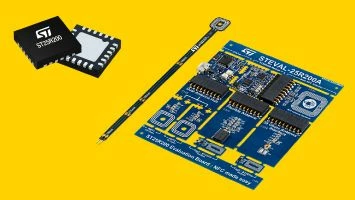
 ST is making it easier to explore creative applications for contactless near-field communication (NFC) technology with a novel development kit featuring the new ST25R200 reader/writer IC. ST’s latest-generation ST25R200 NFC transceiver combines an advanced design for strong and clear wireless connections with low power consumption and controls for signal quality and power management. The STEVAL-25R200SA kit for reader evaluation contains an ultra-compact ST25R200 board, ready for power-up, and multiple antennas that let users try single, dual, and flexible designs. The evaluation kit is complete with a 50-Ohm antenna interface and programmable tags. This modular kit helps quickly build proof-of-concept models to demonstrate convenient short-range wireless communications for device pairing, configuring settings, or product authentication to ensure brand protection. The main board and antennas are NFC-certified and suitable for diverse industrial, consumer, and health technologies, such as medical devices, power tools, household appliances, game consoles, and personal care devices. “The ST25R200 has been crafted for developers, who may not be experts in NFC technology, with the aim of easing the design process,” commented Patrick Sohn, NFC Tags and Readers Business Unit Manager, STMicroelectronics. “The chip offers a high performance-to-cost ratio, expanding design margin, and the STEVAL-25R200SA evaluation kit offers a large set of ready-to-use antenna configurations.” The ST25R200 NFC reader features ST’s noise suppression receiver (NSR), which ensures high immunity to interference even when close to a noise source such as an LCD panel contained in the same device. The receive circuitry also features an advanced analog front end (AFE), standard NFC-A/B (ISO 14443A/B) and NFC-V (ISO 15693) data framing. Enhanced low-power card detection (LPCD), also built-in, eases wake-up to ensure a smooth and seamless user experience. The 1.2W transmitter has dynamic power output (DPO) control to regulate the field strength and overshoot/undershoot protection to ensure consistent signaling throughout data exchanges. This reader operates over a wide power supply and peripheral I/O voltage range from 2.7V to 5.5V and from -40°C to 85°C. In addition, there are multiple operating modes to assist power management, cutting the device current to as little as 1µA to extend the runtime of battery-powered applications. In reset mode the IC draws just 0.1µA.   The ST25R200 is in production now, in a compact 4mm x 4mm 24-pin TQFN package that allows small devices to provide contactless card experiences. Pricing starts from $1.99 for orders of 1000 pieces. The evaluation kit, STEVAL-25R200SA, is available through the eStore, at the budgetary price of $61.00. Additional resourcesProduct overview NFC readers Product presentation NFC readers Datasheet ST25R200First published on Jan 23, 2025

Related products:Other hardware and tools
VIPower full bridge with real-time diagnostics reduces complexity and cost of automotive drives

VIPower full bridge with real-time diagnostics reduces complexity and cost of automotive drives

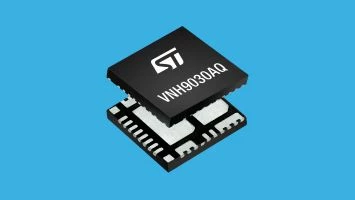
 The VNH9030AQ integrated full-bridge DC motor driver handles diverse automotive uses including functional-safety applications. As well as integrating advanced diagnostics, the driver has a dedicated pin for real-time output status that saves external circuitry and slims the bill of materials.  With RDS(on) of 30mΩ per leg, the VNH9030AQ efficiently handles mid- and low-power DC motor driven applications such as door-control modules, washer pumps, powered lift gates, powered trunks, and seat adjusters.  Contributing to the driver’s high overall efficiency, and saving external components, integrated non-dissipative current-sense circuitry monitors the current flowing through the device to distinguish each motor phase. The standby power consumption is very low over the full operating temperature range, easing use in zonal controller platforms.  The VNH9030AQ integrates the high-side and low-side MOSFETs with gate drivers, diagnostics, and protection against overvoltage transients, undervoltage, short-circuit conditions, and cross conduction. Flexibility to configure the MOSFETs either in parallel or in series allows use in systems involving multiple motors or to meet other specific requirements.  The new driver is part of a family of devices that leverage ST’s latest VIPower M09 technology, which permits efficient, monolithic integration of power and logic circuitry. All products feature an innovative 6mm x 6mm thermally enhanced triple-pad QFN package designed for optimal underside cooling and share a common pinout to ease layout and software reuse.  The VNH9030AQ is in production now and available from $2.48 for orders of 1000 pieces. Additional resourcesProduct overview VNH9030AQ Product page VNH9030AQ Datasheet VNH9030AQFirst published on Jan 20, 2025

Related products:Other hardware and tools
Discover the power of MEMS-Studio: Your ultimate tool for development of sensing applications

Discover the power of MEMS-Studio: Your ultimate tool for development of sensing applications

Are you a developer looking to streamline your workflow with MEMS sensors? Look no further! MEMS-Studio is here to enhance your experience with ST’s MEMS sensors. This intuitive software tool integrates various functionalities, from sensor evaluation to code creation, all in one platform. Why MEMS-Studio?MEMS-Studio combines the best of ST's existing tools like Unico-GUI, Unicleo-GUI, and AlgoBuilder into a single, powerful platform. It offers seamless configuration and testing of in-sensor features such as the finite state machine (FSM), machine learning core (MLC), and intelligent sensor processing unit (ISPU). Key featuresComprehensive sensor evaluation: Easily evaluate a broad range of sensors and visualize data in real-time. No-Code algorithm design: Create and test algorithms graphically without writing a single line of code. Advanced data analysis: Perform runtime and offline data analysis with ease. Broad hardware support: Compatible with STM32 Nucleo boards, SensorTile.box PRO, and more.Hands-on experienceReady to elevate your projects? Dive into MEMS-Studio today and unlock a world of possibilities. Simply connect your evaluation board to your PC, open MEMS-Studio, and follow our detailed guide in the full knowledge article.Additional resourcesOn-demand webinar on MEMS-Studio: Unlocking the power of ST's intelligent sensors using MEMS Studio The official MEMS-Studio webpage for download and much more The user manual UM3233 Getting started with MEMS-Studio The official presentation MEMS-Studio overviewFirst published on Dec 19, 2024

Related products:Other software tools
New STM32Cube ecosystem update

New STM32Cube ecosystem update

The STM32Cube ecosystem is continuously evolving, with the latest release of STM32Cube MCU packages bringing significant updates.   STM32Cube MCU packages provide optimized drivers and middleware, offering full access to hardware features and ready-to-use examples. These packages are extended by STM32Cube expansions, which include additional application-specific middleware and drivers for companion chips.  These essential software components for STM32 devices are regularly updated to support new hardware and include new software examples, enabling developers to achieve more, faster.  Key changes in the latest releaseNew tools and versions: The latest STM32Cube tools include STM32CubeMX configuration tool v6.13.0 and STM32CubeIDE v1.17.0. Additionally, there are new versions for eight existing STM32Cube MCU packages and two brand-new packages to support the introduction of the STM32WL3 series and new STM32N6 microcontrollers. Enhanced STM32C0 package: Now, includes support for the latest STM32C051 and STM32C091/92 microcontrollers. Updated packages: New versions have been released for STM32U0, STM32U5, STM32WB0, STM32WB, STM32WBA, STM32H5, and STM32H7 series. Maintenance updates: Applied to STM32F1, STM32F2, STM32L4, and STM32G4 packages. What can I get from GitHub? All STM32Cube MCU package repositories on GitHub are regularly updated.   HAL driver directories are submodules of specific repositories and are updated roughly monthly. To stay informed, follow the HAL repositories for specific STM32 series.  For the latest GitHub news, subscribe to the STM32Cube MCU Overall Offer discussion or read the STMicroelectronics GitHub blog post.  How to get more details about what is new or what was changed in each release?  1) If you download the STM32Cube MCU package from st.com, you will obtain a .zip file. Once the package is unzipped, you can find a Release_Notes.html at the root. For instance, at the root of the STM32Cube_FW_N6_V1.0.0 folder. 2) If you are working in STM32CubeMX, the STM32Cube MCU package is downloaded by the tool and stored under C:\Users\’your windows user name’\STM32Cube\Repository\. 3) In the GitHub repository, for proper rendering, do not click on the Release_Notes.html file. Click on the README.md file to open it in your browser, and you will find a link to the release note inside. This is the fastest way to read the release note without downloading the full package. To discover the latest updates for each MCU package, download the PDF attached. Additional resourcesProduct overview: STM32Cube MCU packages  Product overview: STM32Cube Expansion Packages Product overview: STM32CubeMXFirst published on Dec 17, 2024

Related products:STM32 software tools
250W MasterGaN reference design fast-tracks compact, efficient industrial power supplies

250W MasterGaN reference design fast-tracks compact, efficient industrial power supplies

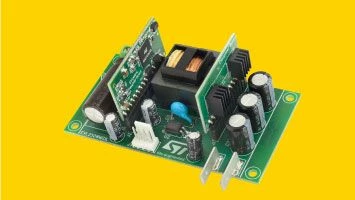
Accelerating the design of gallium-nitride (GaN) power supplies (PSUs) that deliver superior efficiency and power density, STMicroelectronics has launched the EVL250WMG1L resonant-converter reference design based on the MasterGaN1L System-in-Package (SiP). ST’s MasterGaN SiPs combine GaN power transistors with gate drivers specially optimized to ensure fast and perfectly controlled switching. Using these SiPs in place of an equivalent network of discrete components helps maximize performance and reliability while also accelerating design and saving PCB space. The new reference design targets industrial applications where space is limited and efficiency is critical. Combining the MasterGaN1L, which contains two 650V 150mΩ GaN FETs, with ST’s L6599A resonant controller, the PSU achieves peak efficiency over 94% and operates without heatsinks on the primary side. Also leveraging ST’s SRK2001A synchronous-rectification controller, the unit has a compact overall footprint of 80mm x 50mm and outstanding power density of 34 Watts per cubic inch (W/inch^3). The PSU can deliver up to 10A output current, equivalent to 250W at 24Vdc, while also having standby current consumption below 1µA for excellent energy saving. Protection features built into the L6599A and SRK2001A ensure resilience against overcurrent, short-circuit and overvoltage, while input-voltage monitoring ensures correct startup and provides under-voltage lockout. Key featuresHigh efficiency and compact solution for DC-DC conversion using MasterGaN1L Output voltage: 24 V Output power: up to 250 W Nominal input voltage: 400 V +/- 10% Efficiency: > 92% Outputs protected against short-circuit and overcurrent Input voltage monitor for correct sequencing as D2D converter, and brown-out protection Board size: 80 x 50 (W x H) mm. Maximum components height: 30 mm WEEE and RoHS compliant  The EVL250WMG1L is available now, fully built and ready for evaluation, for $250.00. Comprehensive related documentation is published on the product page to help system designers accelerate their GaN power projects. Additional resourcesProduct overview EVL250WMG1L Data brief EVL250WMG1LFirst published on Dec 3, 2024

Related products:Other hardware and tools
Configurable power-management IC for automotive microcontrollers

Configurable power-management IC for automotive microcontrollers

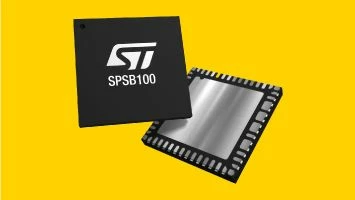
ST has revealed a flexible power-management IC for highly integrated processors like Stellar automotive microcontrollers that lets users program the power-up sequence and fine-tune output voltages and current ranges to fulfill system requirements. The SPSB100 can be used throughout vehicles, in zonal control unit (ZCU), vehicle control platform (VCP), body control (BCM), and gateway modules. The SPSB100, with three switched-mode buck converters and two linear voltage regulators (LDOs), supplies the voltage rails required for the system microcontroller and can power external peripheral loads and sensors. Additionally, there are two wake-up inputs and advanced failsafe functionalities. An internal boost controller stabilizes the power during transients such as cold-cranking pulses, start/stop operation, and weak battery conditions. All the SPSB100 buck converters have overcurrent detection and current limiting for safety, with built-in soft start to prevent excessive inrush currents. Two of the converters can deliver up to 3A output current at a selectable output voltage of 3.3V, 5V, or 6.5V. The third converter can deliver up to 6A at 3.3V, 1.25V, 1.2V, 1.1V, or 0.98V. Among the LDOs, one has a fixed 5V output capable of sourcing up to 120mA with 2% accuracy. The second can be configured to track any of the buck converters at 3.3V or 5V. There is also one high-side driver, which provides open-load and over-current diagnostics. Further features include integrated non-volatile memory (NVM) for storing the output-voltage values and power-up sequence. An SPI port allows programming and supports control and diagnostics, allowing designers to use the SPSB100 in many electronic platforms that require different rails and peripherals. The SPSB100 has a deep-sleep mode that draws less than 40µA quiescent current. There is also a dedicated interrupt pin for failure communication, a microcontroller-reset generator, and overtemperature warning and protection. Documentation is available for applications that must fulfill Automotive Safety Integrity Level (ASIL) requirements in accordance with ISO 26262 for functional safety. Although fully configurable, the PMIC is supplied in one of two pre-programmed configurations, SPSB100B or SPSB100P respectively, for directly powering the core or the internal switched-mode power supply of the microcontroller.  The SPSB100 is AEC-Q100 qualified and available now in an 8mm x 8mm VFQFN56 package, from $2.40 for orders of 1000 pieces. Additional resourcesProduct overview SPSB100 Datasheet SPSB100First published Dec 2, 2024 

Octal automotive gate driver with patented features reducing motor-drive bill of materials cost

Octal automotive gate driver with patented features reducing motor-drive bill of materials cost

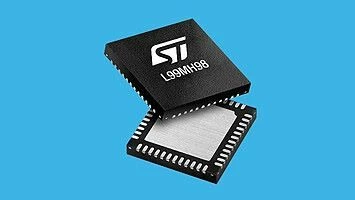
ST’ L99MH98 8-channel gate driver brings patented features for building automotive motor drives without sensing resistors, reducing power dissipation and the bill of materials. The L99MH98 can drive four external full bridges, eight half bridges or single high-side/low-side powering mechanisms such as seat-position adjusters, window lifters, sunroofs, pumps, seatbelt pretensioners, and other actuators. The L99MH98 can also drive resistive loads such as heaters, and the internal circuitry contains a charge pump whose output can control a reverse-battery protection MOSFET. While the drivers can control both logic-level and standard-level MOSFETs, extended gate current capability, programmable up to 120mA, permits driving large numbers of external MOSFETs. Three-stage gate control, which applies the gate signal in three steps, helps to minimize electromagnetic emissions. Designed to provide each MOSFET’s drain-source voltage (VDS) to an analog-digital converter (ADC), the L99MH98 leverages indirect current measurement to replace sensing resistors. This ST-patented technique calculates the drain current in each MOSFET by combining the measured VDS with RDS(on) predicted using sensed temperature. The system is calibrated at manufacture to find the nominal RDS(on) values, enabling predictions to be made using the MOSFETs’ resistance-versus-temperature curves. A further feature, also ST-patented, is the programmable multi-failsafe function that enhances reliability by turning off bridges individually to protect against faults while allowing unaffected bridges to operate normally. Multi-failsafe detects faults including supply overvoltage, high-side over/undervoltage, thermal warning, charge-pump failure, VDS-monitoring failure, and selectively turns off functions such as diagnostics, watchdog, and charge pump depending on fault type. The L99MH98 is AEC Q100 qualified and meets ISO 26262 criteria for functional-safety applications up to safety integrity level (ASIL) B. Available now in a VFQFN48L package with wettable flanks and exposed underside cooling pad, the L99MH98 is priced from $2.44 for orders of 1000 pieces. Additional resourcesL99MH98 product overview L99MH98 datasheetFirst published on Nov 27, 2024

Related products:Other hardware and tools
Speed up your prototyping and achieve modern displays with STM32C071

Speed up your prototyping and achieve modern displays with STM32C071

The STM32C0x1 MCUs feature the Arm Cortex®-M0+ core and run up to 48 MHz. Compact, affordable, and reliable, the STM32C071 product line includes a USB host and crystal-less device, up to 128 Kbytes of flash and 24 Kbytes of RAM. With larger memory options and USB connectivity, the STM32C071 line now gives more flexibility to upgrade existing applications and create new products. The line also offers 12-to-64-pin packages, in WLCSP, TSSOP, UFQFPN, LQFP, UFBGA profiles. Replace traditional segment displays with modern graphical display solutions thanks to the NUCLEO-C071RB The STM32C0 Nucleo board, NUCLEO-C071RB, helps you achieve modern display capabilities, particularly ideal for STM32 entry-level graphics. By replacing traditional segment displays with modern graphic display solutions, it offers a smartphone-inspired user experience.This upgrade is cost-effective, ensuring a minimal increase in the bill of materials (BOM) cost. TouchGFX, a free GUI tool, simplifies development by offering all the necessary resources to create cutting-edge graphical user interfaces (GUIs). The ST solution features the X-NUCLEO-GFX01M2, which comes with a 2.2” SPI QVGA display boasting a resolution of 320 x 240. Additionally, Riverdi, an ST partner and TouchGFX expert, provides a solution which features an extension display, the RVA15AD-NUCLEO64A, a 1.54” SPI IPS display with a resolution of 240 x 240. This is also compatible with the Nucleo-64 board.This is fully supported in TouchGFX, a free, comprehensive, and accessible tool for modern display development and cutting-edge GUI creation. The STM32C071 MCUs are in production now, priced from $ 0.53 in the TSSOP-20 package and $0.73 in LQFP64 for orders of 1000 units. Additional resourcesEasily develop smartphone-like GUIs TouchGFXDesigner STM32C0 seriesFirst published on Nov 26, 2024

Related products:STM32 products and hardware tools
STM32WL33 low-power, long-range microcontrollers with dedicated ecosystem extensions now available

STM32WL33 low-power, long-range microcontrollers with dedicated ecosystem extensions now available

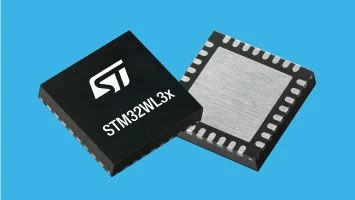
ST has announced the general availability of the STM32WL33 wireless MCUs, which integrate the latest-generation sub-GHz long-range radio and Arm® Cortex®-M0+ core. These MCUs are designed to simplify wireless solution designs, reduce time-to-market, and prolong battery life, making them ideal for various applications. Key benefits for developers Device-specific software and middleware:Access to STM32CubeWL3 software and middleware Support for development boards like NUCLEO-WL33CC1 (868/915 MHz) and NUCLEO-WL33CC2 (433 MHz)  Power efficiency and design:Ultra-low-power architecture: Optimizes wireless range, simplifies design, extends battery life LCSC flow-sensor controller: Optimizes water metering devices, operates with traditional meters, provides anti-tampering, extends battery life to over 15 years Receive-only wideband radio: Ultra-low-power (4.2 µA), listens for wake-up signals, negligible battery impact, supports drive-by reading and wake-on-serviceIntegrated features:Memories and peripherals: 256 Kbytes flash, 32 Kbytes SRAM, 16-segment LCD driver, 12-bit ADC, analog comparator, DAC, multiple timers, RTC Security: Secure-boot, secure firmware updates, 128-bit AES, RNG Frequency bands: Operates in 413-479 MHz, 826-958 MHz, and 169 MHz bands Power amplifiers: Selectable RF output power of +14 dBm or +20 dBm, compliant with global regulationsRadio capabilities:Multi-protocol support: 4-(G)FSK, 2-(G)FSK, (G)MSK, DBPSK, DSSS, ASK Radio sequencer: Automates radio operations, enhances efficiency Receive sensitivity: -132 dBm @300 bit/s 433 MHz OOK, -128 dBm @300 bit/s 868 MHz 2(G)FSK IQ interface: Custom modulation schemes, enhanced reception sensitivity, supports GNURadio. Supporting standard protocols like wM-Bus, Mioty, Wize, Sigfox, 6LowPAN, and Wi-SUN HAN, along with customizable proprietary options.Application integration:Seamless integration with ST’s MEMS inertial and environmental sensors Leverages ML/AI algorithms and toolsets for applications requiring positional and contextual awarenessApplications: Smart utility meters, alarm systems, smart-building equipment, asset-tracking, proximity detection, smart cities, smart agriculture, forest-fire detection, water metering, leakage detection. As an all-in-one SoC, the STM32WL33 series connects developers with the extensive STM32 ecosystem, including STM32CubeWL3 software, middleware, and development boards like NUCLEO-WL33CC1 for 868/915MHz and NUCLEO-WL33CC2 for 433MHz. Dedicated matched filters (MLPF-WL-01D3/02D3/04D3) optimize RF performance. Pre-certified reference designs (STDES-WL3xxxx) simplify RF design and cover various options, including frequency band, RF power, MCU package, and PCB configurations. Enhanced development experience with the Wireless Studio Environment (WiSE):WiSE, a graphical-UI based toolset, greatly boosts the learning curve and out-of-the-box experience. This includes the WiSE-RadioCodeGen, a code generator for RF-protocol automation that comes with the dedicated WL33 Radio Sequencer, and the WiSE-RadioExplorer. The explorer helps users make the most of the cutting-edge radio features and navigate the RF testing and certification process.  Pricing and availability:The new STM32WL33 devices are competitively priced, starting from $2.03 for the STM32WL33K8V6 in a QFN32 package for orders of 10,000 pieces. The development boards, NUCLEO-WL33CC1 and NUCLEO-WL33CC2, are available now from the eSTore and ST distributors for $50.00 each. Additional resourcesSTM32WL3x product overview STDES-WL3xxxxx data briefFirst published on Nov 25, 2024

Related products:STM32 products and hardware tools
Failsafe comparators with guaranteed start-up time boost reliability and power savings

Failsafe comparators with guaranteed start-up time boost reliability and power savings

TS3121 and TS3121A rail-to-rail, open-drain, single channel comparators feature a novel failsafe architecture and guaranteed start-up time that simplify powering up for short periods to minimize consumption in low-power applications. Ideal for use in industrial controls, building automation, power tools, smart metering, as well as in automotive powertrain and body-control modules. The failsafe architecture allows analog sensor voltages to remain at the inputs when the supply voltage is cut, which ensures robust performance and helps simplify application firmware. The guaranteed start-up time allows frequent power cycling with extended off duration for maximum power savings. Inspired by industrial robots that use sensors running from a back-up battery to maintain positional awareness while the main system turns off saving power, these comparators fulfill diverse automation applications. Also featuring independent supply, I/O, and output voltage domains that allow flexible level shifting, they are ideal for use in industrial controls, building automation, power tools, and smart metering. In addition, both the TS3121 and TS3121A are available as automotive-qualified devices that are suited to use in applications such as powertrain and body-control modules. The comparators operate over a wide supply-voltage range, from 1.7V to 5.5V, and feature a precision input stage that facilitates accurate threshold detection with typical propagation delay of 60ns. Both devices have typical input-offset voltage of 0.5mV, with a specified maximum offset of 2mV for the TS3121A and 6mV for the TS3121. Both tolerate ESD up to 4kV (HBM), and operate over the extended temperature range from -40°C to 125°C. The comparators are available in space-saving SC70-5 and standard SOT23-5 packages. All features: Low offset voltage: 2 mV max @ 25 °C (A-grade version) Input/output pins withstand voltages higher than VCC Low power consumption: 70 μA typ Fail-safe architecture keeps output in high impedance when VCC = 0 V Wide supply voltage: 1.7 to 5.5 V Guaranteed start-up time allows sequential on/off cycles of VCC Propagation delay: 60 ns High ESD tolerance: 4 kV HBM Rail-to-rail input Extended temperature range: -40 to +125 °C Open-drain output AEC-Q100 qualified Fail-safe input/output pins Safety capable: documentation available to aid functional safety system design The TS3121 and TS3121A are available now, priced from $0.60 for orders of 1000 units and free samples of the TS3121 and TS3121A are available on the ST eStore. The comparators are included in ST’s 10-year longevity program that guarantees long-term product availability. Additional resourcesComparators overview  TS3121, TS3121A datasheet High-speed 5 V comparators presentationFirst published on Nov 21, 2024

Related products:Other hardware and tools
Standard-threshold 40V MOSFETs in enhanced STripFET F8 technology released

Standard-threshold 40V MOSFETs in enhanced STripFET F8 technology released

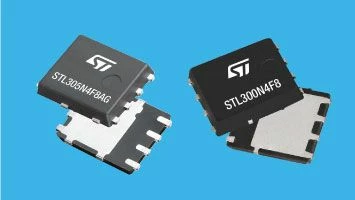
ST has introduced 40V STripFET F8 MOSFETs with standard threshold voltage (VGS(th)), combining the advantages of the enhanced trench gate technology with superior noise immunity for applications with non-logic-level control. The industrial-grade STL300N4F8 and automotive-grade STL305N4F8AG MOSFETs have a drain current rating above 300A and maximum RDS(on) of 1mΩ, permitting outstanding efficiency in high-power applications. Enhancing dynamic performance, the total gate charge of 65nC (typical) with low device capacitances (Ciss, Crss) ensure minimal losses at high switching frequency. The MOSFET body diode assists efficiency and reliability with low forward voltage and fast reverse recovery. With the new device series, designers can take advantage of ST’s latest STripFET F8 technology in power supplies, converters, and motor drives of equipment like cordless appliances and industrial tools. The MOSFETs’ efficiency extends runtime per battery charge and reduces heat dissipation allowing operation at sustained high output with simplified thermal management to save space and lower bill-of-materials costs. The automotive-qualified devices target motor drives and DC/DC converters throughout the vehicle, including body electronics, chassis, and powertrain systems. Applications include window lifters, seat positioners, sunroof openers, fans and blowers, electric power steering, active suspension, and control systems for emissions reduction. ST’s STripFET F8 technology ensures ruggedness within a large safe operating area (SOA), enabling the devices to handle high power levels that impose large drain-source voltage (VDS) drops. In addition, the high maximum operating junction temperature of 175°C lets the MOSFETs withstand harsh usage in extreme environments. In addition, the technology enables a small die size allowing low RDS(on) at a competitive price in a package that has a compact footprint. Both devices are available in a space efficient PowerFLAT 5x6 package, also including the wettable flanks option requested by the automotive industry. The STL300N4F8 is available now priced from $0.8370 for orders of 1000 units. The STL305N4F8AG is priced from $0.9730 per 1000 units. Additional resourcesSTripFET F8 Series overview STripFET F8 introduction video STL300N4F8 datasheet STL300N4LF8 datasheetFirst published on Nov 18, 2024

Related products:Other hardware and tools
IO-Link actuator board delivers turnkey reference design for industrial monitoring and appliances

IO-Link actuator board delivers turnkey reference design for industrial monitoring and appliances

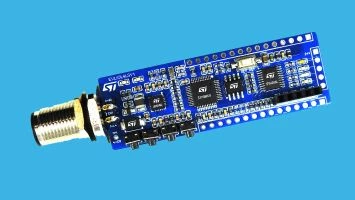
ST has introduced an IO-Link reference design for industrial beacons and home-appliance alarms, delivered ready-to-use as a fully built board complete with protocol stack and application software. The EVLIOL4LSV1 board leverages ST’s L6364Q dual-channel IO-Link transceiver to handle communications and the IPS4260L intelligent low-side power switch for driving the indicator lights. The board can be directly connected to signaling systems such as smart tower lights used in factory automation, funnel material alarms for quantity-remaining or urgency-level awareness, and other system warnings. It also provides a fast way to test the IPS4260L and L6364Q ICs and has a 4-pin M12 connector for an IO-LINK master and a 5-pin SWD connector for programming. An STM32G071CB microcontroller, which hosts the ST proprietary IO-Link demo stack and the application software, handles system control and diagnostics, communicating with the transceiver and low-side switch. The L6364Q transceiver is fully protected and supports standardized IO-Link communication speeds including 38.4kbit/s COM2 and 230.4kbit/s COM3. The transceiver can operate in single or multibyte mode, as well as in transparent mode delegating control of IO-Link communications to the microcontroller by a simple URT interface. The in-built protection ensures EMC immunity up to 2.5kVpk surge pulse/500Ω coupling without additional protection elements. The IPS4260L low-side driver has four outputs for driving loads with one side connected to supply voltage, each individually controlled by a signal such as a digital microcontroller output. It has a wide operating-voltage range, from 8V to 50V, and the current for each output can be independently programmed from 0.5A to 3.0A. The IC integrates overload and overtemperature protection for each channel and provides open-load, overload, and overtemperature diagnostic signals to aid system management and enhance reliability. The reference design also features ST’s SMBJ30CA TVS (transient-voltage suppression) diode to withstand surge pulses with 2Ω coupling on the supply rail. The EVLIOL4LSV1 is available now from the eSTore and ST distributors for $23. Additional resourceData brief EVLIOL4LSV1First published on Nov 12, 2024

Related products:Other hardware and tools
Secure manager V1.2.0 for STM32H5: upgraded security and more

Secure manager V1.2.0 for STM32H5: upgraded security and more

The new version of Secure Manager for STM32H5 is now available, offering significant security improvements and new features that are highly beneficial for developers. Key benefits of secure manager V1.2.0Enhanced security: significant improvements to make applications more resilient against threats Third-party security services: new support from ST partner, ProvenRun, offering standard and premium support, optional professional services, and more Footprint optimizations: increased maximum allowed application size AES GCM multipart support: improved encryption capabilities Improved debug capabilities: enhanced tools for better debugging  How secure manager V1.2.0 enhances securitySecurity within an MCU or MPU application is complex and costly. The new European Cyber Resilience Act mandates that every digital object must focus on cybersecurity. Secure Manager V1.2.0 addresses these requirements seamlessly:Security by design: high security service design maintained and corrected by ST for vulnerabilities Strong Root of Trust: two-stage Root of Trust for application verification of authenticity, integrity, and confidentiality Security updates: PSA API-compliant solution for updating applications and secure modules independently Secure communication: ensures mutual attestation and data privacy  Secure manager leverages decades of security expertise from embedded software developers and partners. It has been tested and certified by external, highly skilled security laboratories, ensuring it can withstand multiple threats, including physical attacks. Details of the new updates are described inside the user manual at Secure Manager for STM32H573xx microcontrollers - User manual. Download the latest version now. Additional resources STM32Trust - Our security repository for all STM32 STM32H5 Online security trainings - Training of all our security IPs and services Secure manager presentation - Explains what Secure Manager is and provides a marketing overview of the functionalities and support services Wiki Security H5 Wiki Secure Manager First published on Nov 12, 2024

Related products:Other hardware and tools
New STSPIN32G0 series of motor drivers for industrial applications and home appliances

New STSPIN32G0 series of motor drivers for industrial applications and home appliances

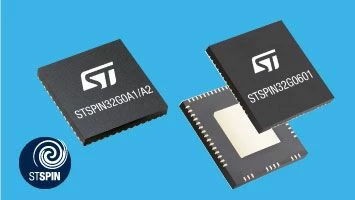
ST’s STSPIN32 drivers combine a general-purpose STM32 microcontroller (MCU) with a feature-rich three-phase gate driver to simplify design, save PCB area and accelerate time to market. The eight new STSPIN32G0 devices contain gate drivers rated 45V, 250V and 600V, targeting applications from battery-operated appliances and power tools to industrial automation, robots, HVAC systems and line-powered home appliances. The new devices integrate an STM32G031 microcontroller, based on the Arm® Cortex®-M0+ core, which has the computing power to handle popular control algorithms, including six-step control and field-oriented control (FOC). FOC implementation can be sensored or sensorless, with one, two, or three shunts. Additional features that help simplify system design include a 12-bit ADC, internal voltage reference buffer, an advanced motor-control timer, and digital interfaces including I2C, USART, and SPI. Up to 32 general-purpose I/O pins (GPIOs), 64KB of Flash, and 8KB of SRAM give developers flexibility to host complex applications and innovate value-added features. The four new low-voltage variants are based on a feature-rich 45V gate driver suitable for applications powered from sources such as lithium battery packs or industrial buses up to 36V. Examples include portable power tools and appliances, cordless vacuum cleaners, robots, fans and pumps. The four product variants offer different combinations of analog sensing inputs, GPIOs, and dedicated analog reference-voltage pins. All drivers have 600mA source/sink current capability and also integrate a 3.3V DC/DC converter and 12V linear regulator to power internal circuitry and external devices, making these four devices self-supplied. The four high-voltage variants present a choice of 250V or 600V driver voltage rating and 200mA/350mA or 1.0A/0.85A source/sink current capability. All have ST SmartShutDown capability to guarantee fast protection of the external power stage in case of a fault. They are intended for applications such as home appliances, air conditioners, home and industrial refrigerators, industrial pumps and industrial automation. All STSPIN32G0 devices integrate circuit protection including overcurrent and overload protection, cross-conduction prevention, and undervoltage lockout to ensure system safety and help further simplify the design. An evaluation board is available for each variant, which enables a fast start to new designs and all STSPIN32 family members connect users with the STM32 MCU development ecosystem. This provides an extensive selection of tools, software, and evaluation boards including the X-CUBE-MCSDK motor-control software development kit (SDK) with parameterizable firmware libraries and motor-control workbench GUI. There are also MCU-specific software packs and middleware, and the STM32CubeMX configurator that facilitates project setup and performance analysis. The STSPIN32G0 controllers are in production now and available from $2.00 for the low-voltage variants, in a 7mm x 7mm VFQFPN48, for orders of 1000 pieces. The 250V and 600V variants are $2.14 and $2.44 respectively, both available in a 10mm x 10mm QFN 72L. Additional resourcesProduct overview STSPIN32G0 series Webinar: Get things moving with ST's latest integrated BLDC motor driver, the STSPIN32G0 Video: Meet STSPIN32G0 series Video: Optimize your motor control with our advanced 3 phase controllersFirst published on Nov 11, 2024

Related products:STM32 products and hardware tools
Seamless integration of TTTech's TSN IP into ST's STM32MP25

Seamless integration of TTTech's TSN IP into ST's STM32MP25

TTTech's Time-Sensitive Networking (TSN) switch IP is now integrated into ST's STM32MP25 microprocessor, offering safe and secure connectivity of applications to standard Ethernet networks, with several key benefits for developers addressing switch, PLC or IPC solutions. What's new and its impactTTTech's TSN Switch IP is recognized as the most mature and best-in-class solution available in the market. For developers, this means a reliable and robust networking foundation, reducing the risk of integration issues and ensuring long-term support. The seamless integration of the TSN Switch Core and Endpoint into the STM32MP25 translates to the lowest eBOM for embedded TSN switching and deterministic communication. Additionally, the availability and support of standard-compliant open-source software and configuration tools for the TSN ecosystem streamline the development process. Developers can leverage these resources to accelerate their projects and ensure compliance with industry standards. Key featuresStandards compliance: The TSN IP switch complies with the IEEE 802.1 standards, ensuring interoperability and future-proofing, which is essential for developers aiming for long-term viability of their products. Industry adoption: With TTTech's strong presence in automotive, industrial automation, and aerospace, developers can be confident in the widespread applicability and acceptance of this technology. Deterministic networking: The deterministic along with the low latency capabilities of TSN are critical for applications requiring real-time communication, making it a valuable asset for developers in sectors like industrial automation and aerospace.  The STM32MP25, with its best-in-class performance and ease of configuration, offers full featured industrial TSN functionality. Additional resourcesIntroduction video Case studyFirst published on Nov 7, 2024

Related products:STM32 products and hardware tools
Web-based tool accelerates AIoT projects with smart sensors

Web-based tool accelerates AIoT projects with smart sensors

 ST AIoT Craft, a new web-based tool, simplifies developing and provisioning node-to-cloud AIoT (Artificial Intelligence of Things) projects that use the machine-learning core (MLC) of ST’s smart MEMS sensors. The MLC is unique to the ST MEMS portfolio and enables decision-tree learning models to run directly in the sensor. Capable of operating autonomously, without host-system involvement, the MLC ensures low latency with low power consumption and efficiently handles tasks that require AI skills such as classification and pattern detection.  ST AIoT Craft also integrates all the steps needed for developing and provisioning IoT projects that leverage the MLC for in-sensor AI and offers a secure and user-friendly approach. There is robust cyber protection for data in the cloud and the web-based tool is conveniently accessed online without downloading to desktop. This saves time for users as it requires no installation, and eases collaboration between different team members such as as AI specialists and embedded software engineers.  The tool provided for creating decision-tree models includes the AutoML function, which automatically selects optimal attributes, filters, and window size for sensor datasets. This framework also trains the decision tree to run on the MLC and generates the configuration file to deploy the trained model. For beginners it is a quick and easy introduction to ST smart sensors that simplifies developing AI applications. In addition, to provision the IoT project, the gateway can be programmed with the Data Sufficiency Module (DSM) tool that intelligently filters data points for transmitting to the cloud, to optimize communication and minimize power consumption, and facilitates future retraining.  Users can find examples that show how to work with decision trees to build IoT sensor-to-cloud solutions, including fan-coil monitoring, asset tracking, human activity recognition, and head gestures. The examples are ready to flash and run for evaluation in ST reference IoT boards such as SensorTile.box Pro, STWIN and STWIN.box. Users can customize these examples to accelerate their own projects, bringing their own data or enhancing available datasets.  ST AIoT Craft is included in the ST Edge AI Suite repository. This contains all software tools, examples, and models for developing machine-learning algorithms to deploy on ST edge-AI devices such as STM32 microcontrollers (MCUs), Stellar MCUs, and MEMS sensors that contain the MLC or the intelligent sensor processing unit (ISPU).  AIoT Craft is available free of charge online now. Please visit https://staiotcraft.st.com/index.html to register. Additional resourcesPresentation: Simplifying edge AI deployment in sensor-to-cloud solutions ST Edge AI Suite ST AIoT Craft Blog article: ST AIoT CraftFirst published on Nov 5, 2024 

Related products:Other software tools
Enhancing performance & security with new high-performance STM32H5 MCUs

Enhancing performance & security with new high-performance STM32H5 MCUs

Earlier this year, the launch of the STM32H523 and STM32H533 MCUs expanded the STM32 high-performance portfolio, offering enhanced performance, security, power efficiency, and advanced embedded peripherals. What’s new in the two lines?STM32H523 product line: Memory: 256 to 512 Kbytes of flash memory and 272 Kbytes of SRAM Package options: Available in 48 to 144 pins packages in BGA and LQFP profiles, as well as WLCSP39 and UFQFN48 packages, allowing developers to choose the best fit for their design constraints   STM32H533 product line: Memory: 512 Kbytes of flash memory, offering substantial storage for applications requiring more memory Additional features: Includes an encryption accelerator engine (AES, PKA, and OTFDEC) and ST-iROT, which enhance security features Certifications: Targets SESIP3 and PSA Level 3 certifications   Both lines feature the Arm Cortex®-M33 core with TrustZone® for Armv8-M, DSP, and a floating-point unit (FPU) running up to 250 MHz. Key benefitsMore design freedom and reduced time to market Performance in space-constrained devices Optimized cost & performance trade-off: Based on ST’s optimized 40 nm process technology, these MCUs offer an excellent balance between cost and performance, making them suitable for a wide range of applications  These advancements provide significant benefits for developers, enabling more robust and efficient designs.You can order here.  Additional resourcesBlog article on STM32H523/33 On-demand webinar on STM32H5 MCUs STM32H523/533 MCUs product page STM32H5 MCU overviewFirst published on Oct 18, 2024

Related products:STM32 products and hardware tools
TouchGFX: Are you ready to enhance your user interface design?